Kent State MSN FNP: planning five practicums across a 47-credit degree
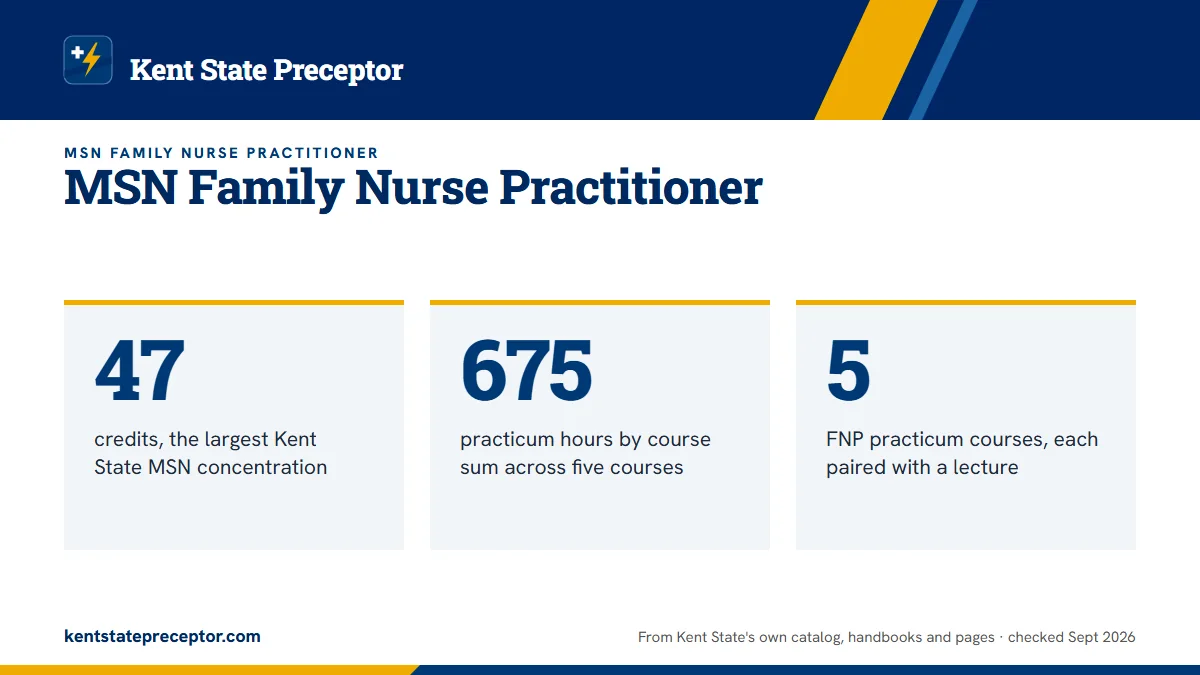
Kent State's Family Nurse Practitioner concentration is the largest MSN plan at 47 credits, taught as a hybrid of online and face-to-face courses. Its five practicums total 675 hours by course sum and reach children, adults and older adults, and each one needs a preceptor that you identify and your practicum faculty approve.
Plan all five FNP placements at once
Tell us your county and which practicum comes first. We line up the preceptor types Kent State's FNP courses ask for.
The FNP degree at a glance
Forty-seven credits make up the FNP: 35 in the concentration itself and 12 in the core every Kent State MSN student takes. No other MSN concentration at Kent State is larger. The catalog labels it mostly online, and the FNP program page calls it a hybrid: most coursework is online, and some courses meet face to face at the Kent Campus.
Kent State has not published how many campus sessions the FNP includes or which courses carry them. Get the dates from your graduate advisor early, because they will sit beside your practicum days once clinical work begins.
The clinical courses rest on four APRN foundation courses: NURS 60015 Advanced Health Assessment, NURS 60045 Pathophysiology for the APRN, NURS 60441 Pharmacology for the APRN and NURS 60506 Clinical Diagnostics for Advanced Practice Nurses. The catalog prints no MSN roadmap, so the term order of these courses and the five practicums is entered in your Graduate Planning System (GPS) plan after admission.
When the first FNP practicum falls
NURS 61292 Adult Gerontology Primary Care I Practicum is where FNP clinical work begins. It needs Advanced Health Assessment completed, takes pharmacology and diagnostics as pre- or co-requisites, and requires special approval plus full clinical compliance before you can register. Read together, those rules put your first practicum no earlier than the term after NURS 60015.
Your search starts well before that term. A mandatory orientation for first practicums runs 4 to 6 months ahead of the course, and the concentration coordinator helps with the first site and preceptor during the semester before it. For most FNP students, that means looking for an adult primary care preceptor while still taking the foundation courses. The orientation planning guide turns this into a month-by-month plan.
Clinical compliance is a condition of registering for NURS 61292. Finish every item before registration opens, not during the course.
Five practicums, 675 hours by course sum
Each FNP practicum is taken with a paired lecture, and each has its own page on this site covering the preceptor, the setting and the weekly schedule. The table lists them in catalog order; your GPS plan sets the terms.
| Practicum | Credits | Hours | Paired lecture | Patients and focus |
|---|---|---|---|---|
NURS 61292 Adult Gerontology Primary Care I | 2 | 150 | NURS 60120 | Adults and older adults in primary care |
NURS 61692 Primary Care Pediatrics | 2 | 150 | NURS 60160 | Children in primary care |
NURS 61892 Family and Adult Gerontology NP Role | 1 | 75 | NURS 60125 | The nurse practitioner role |
NURS 62292 Primary Care II: Chronically Ill Adults | 2 | 150 | NURS 60220 | Chronic illness, with specialty blocks |
NURS 63292 Family Health and Chronic Illness | 2 | 150 | NURS 60325 | Every age, family health and chronic illness |
| Total by course sum | 9 | 675 |
The 675 total is our addition of the hours printed in each course description. Yet the catalog's graduation rule for the MSN, written for every concentration at once, sets a minimum of 300 to 600 clinical hours, varying by concentration, and 675 sits above that range. Go by your syllabus and your concentration coordinator, and see FNP clinical hours for the breakdown. FNP certificate students may see NURS 61692 listed at 1 or 2 credits, so their pediatric block can be 75 hours or 150.
The preceptors across an FNP plan
One FNP degree needs several kinds of preceptor. Kent State's FNP rotation page names an FNP, an adult-gerontology NP or a physician for adult and family practice. For the children's course it asks for a pediatric nurse practitioner, a pediatrician, or an FNP with a child-focused practice, and it advises against pediatric specialty hours.
Specialty time enters with the chronic illness course, where the rotation page sketches specialty blocks in cardiology and endocrinology, each around 35 to 40 hours. The last practicum spans the lifespan, and Kent State notes it may take a second site to reach every age group. Kent State's rotation pages ask each APRN preceptor for a year or more of practice in the population focus and in the role, and the college recommends one preceptor for two students when the preceptor is not carrying their own patients, one to one when they are.
Settings Kent State names for FNP work include family practice, internal medicine, ambulatory and specialty clinics, managed care, long-term care, and academic and occupational health, and the catalog adds emergency departments. Whatever the setting, hours count only where the College of Nursing holds a current affiliation agreement with the facility.
Enrolling states and licensure
The FNP has no place on Kent State's list of approved states for online learning, a list built only for fully online programs, and the college has not published where hybrid FNP students may enroll from. If you live outside Ohio, get a written answer from Kent State's Office of Academic Advising and Student Services ahead of applying. Planning a move mid-program? Report it to the Office of Student Services first, since some state laws block practicum courses.
Clinical hours happen face to face, under an RN license from the state you train in, and that license must be active and unrestricted. Looking further ahead, Kent State's licensure disclosure table says the MSN NP concentrations do not meet educational requirements for licensure in California, New York and American Samoa, and meet them in the other 53 jurisdictions listed. Some Kent State program pages still describe that determination as not yet made, a conflict set out on licensure disclosures.
Certification and finishing on time
FNP graduates are educationally eligible for the family nurse practitioner certification exam from either the ANCC or the AANP. According to Kent State, finishing an APRN concentration also qualifies you for APRN licensure in Ohio, though other states may add their own requirements. Near graduation, the concentration coordinator handles the certification and licensure paperwork for you.
Two catalog rules shape a long plan. Stop out, and any practicum that has aged three years or more must be taken again along with its lecture, so a part-time student who took NURS 61692 early and then paused can lose those hours. The degree also needs a 3.000 overall GPA.
Hours count only on days when every compliance item is current. An annual TB test or flu vaccine that lapses mid-semester stops your hours until it is renewed, which is easy to miss across a five-course sequence.
Why Kent State FNP students choose us
An FNP plan calls for a wider spread of preceptors than the adult-only primary care track: adult and family practice, a pediatric preceptor, specialty blocks, and a final site that reaches every age. We map all five courses at the start of your search, so each placement is lined up a term ahead instead of pieced together after the last one ends.
For every course we look for preceptors in person in your own community and hold each one to Kent State's rules on license, certification and a full year in the population focus. The site and preceptor file we build for you is what your practicum faculty and concentration coordinator need for approval, complete on the first pass. If a practice has no College of Nursing affiliation agreement, you hear it from us early enough for the college to arrange one.
Should a preceptor step away partway through, we remain on call and start a replacement search right away. Share your GPS plan and home county in the form below, and we will begin mapping all five courses.
Questions Kent State students ask
Is Kent State's FNP program online?
Mostly. The catalog labels the FNP concentration mostly online, a Kent State term for programs delivered at least half online, with a few courses that need you on campus, and the FNP program page calls it a hybrid of online and face-to-face courses. The number and dates of campus visits are not published. Practicum is always in person, with a preceptor near where you live.
How long does the Kent State MSN FNP take?
Kent State's FNP page says the degree can be done in as little as two years of full-time study, or about three years while working, and the catalog's MSN page gives three to four years for part-time study. The master's has to be completed within six calendar years of your admission term. The exact order of your terms, including when each practicum lands, is set in your GPS plan.
What is the difference between Kent State's FNP and AGPCNP?
The two concentrations have three practicums in common, the first primary care course, the role course and the chronic illness course. The FNP adds the pediatrics practicum NURS 61692 and finishes with the lifespan course NURS 63292, while the AGPCNP finishes with NURS 63692. That gives the FNP 47 credits and 675 hours by course sum, against 41 credits and 525 hours for the AGPCNP.
Can my own employer host my Kent State FNP practicums?
Kent State publishes an outright workplace ban only for the PMHNP. No public rule bars an FNP student's employer, so the decision sits with your practicum faculty and concentration coordinator. Ask them before you plan around it. Your employer would still have to be under agreement with the College of Nursing, and the preceptor would still have to meet the course's rules.
Do I need an Ohio RN license for the Kent State FNP?
You need an Ohio license for any course taken on the Kent Campus and for practicum done in Ohio. A student who lives and does practicum in another state needs that state's license instead. The catalog allows proof within the first semester or before practicum hours, while the MSN handbook asks for it before you register, so have the license in hand early.
Related pages
Last checked 2026-09-24
We check these pages against Kent State's own catalog, handbooks and program pages. Your MSN or DNP handbook, your syllabus, your practicum faculty and your concentration coordinator have the final word.
Kent State says the preceptor search is yours. We make it the fastest part of your practicum.
Tell us your Kent State concentration, where you live and which semester your next practicum starts. We find preceptors who fit the course and prepare everything your practicum faculty and coordinator review before they approve.
- Preceptors matched to the course: primary care for
NURS 61292, acute care forNURS 61092, psychiatric care forNURS 61592, women's health forNURS 66192 - Credentials, license and site details ready for your practicum faculty and coordinator
- In your own community, in Ohio or wherever you live and hold your RN license
Start your placement plan
Program, city and semester is all we need to begin.