Who can precept a Kent State graduate nursing student
Kent State lets five kinds of clinicians precept graduate nursing students: APRNs, physicians, physician assistants, Certified Nurse Educators and healthcare administrators. Each needs an active, unrestricted license and certification, a year or more in clinical practice and a green light from their employer. Your concentration then adds its own conditions, and practicum faculty with your concentration coordinator sign off on every match.
Get preceptors who already fit
Tell us your concentration and next practicum course. Your placement advisor replies with how we match preceptors to Kent State's rules for it.
The baseline every graduate preceptor meets
Kent State's Become a Preceptor page sets four conditions for anyone precepting graduate nursing students. They hold across the MSN concentrations, the post-master's certificates and the DNP.
Kent State's graduate preceptor criteria
- Role: an APRN, physician, physician assistant, Certified Nurse Educator or healthcare administrator.
- License and certification: active and unrestricted, in the preceptor's area of practice.
- Experience: at least one year of clinical practice.
- Employer approval: sign-off from the preceptor's employer and practice setting.
The APRN rotation pages set a tighter bar, citing accreditation: before precepting NP, CNS, PMHNP, WHNP or PNP students, the clinician needs twelve months or more working in that same population focus and role. A family NP eight months into the role misses that bar, whatever their years as an RN.
Those rotation pages appear to predate 2025, so treat them as a floor and confirm current expectations with your practicum faculty.
Ratios, CVs and how preceptors come on board
Kent State's recommended ratio hinges on caseload. A preceptor who is not carrying patients of their own during the rotation may take two students; one who is carrying a caseload takes one. Most NP preceptors see their own patients, so most NP placements run one to one.
The preceptor's own paperwork is short. Each preceptor forwards a current CV to your graduate faculty member. A clinician precepting for Kent State for the first time starts with an online interest form built in Qualtrics, and the college then guides the employer-approval step. As each term begins, your assigned faculty member sends the preceptor course syllabi, contact details, useful links and a Typhon guide written for preceptors.
Once hours begin, preceptors can view your hours log and schedule in Typhon, and filing your final evaluation there is their job. Kent State posts no graduate preceptor agreement and no license-verification form, which puts real weight on the CV and credentials you help pull together.
Concentration rules at a glance
Each concentration's Clinical Rotation Descriptions page adds rules on who precepts and where. The table condenses them; your course syllabus and practicum faculty settle the details.
| Concentration | Who can precept | Setting rules to plan for |
|---|---|---|
| FNP | FNP, AGNP or physician for adult and family care; PNP, pediatrician or pediatrics-focused FNP for pediatrics | Cardiology and endocrinology blocks of roughly 35-40 hours; the final lifespan practicum may need a second site |
| AGPCNP | NP or physician in internal medicine, primary care, express care or long-term care; CNS or PA with faculty approval | No more than 40 hours in one specialty; at least 16 underserved-care hours in the summer practicum |
| AGACNP | CNP, MD or DO in hospital settings, including critical care | 16-20 clinical hours a week; final practicum in 2-3 unfamiliar specialties |
| PMHNP | Practicum I: psychotherapy-experienced provider; II: prescriber; IV: PMH APRN for half the hours or more | Lifespan experience; never the student's own workplace |
| WHNP | CNM, WHNP, FNP or general OB/GYN; FNP, adult NP or family-practice MD for women's primary care | Settings with good GYN or OB volume |
| AGCNS | CNS in acute care or ambulatory settings, with a direct-care partner when needed | Later practicums need all three spheres; at least two agencies overall |
| Nurse Educator | Experienced nurse educator | Academic or staff-development setting |
| NAHSL and MSN/MBA | Master's-prepared leader, MSN preferred, one or two levels above your role | Look beyond your own unit or employer; site project at about 10 hours a week |
| PNP (continuing students) | Primary care preceptors in offices, clinics or health departments | Retail minute clinics excluded; later practicums shift to chronic-care specialties |
The concentrations that need several preceptors
Three concentrations write more than one preceptor into their rules, and seeing that early changes how you search. In the PMHNP practicums, the first course pairs you with a licensed clinician who practices psychotherapy (a PMH APRN is ideal but optional), the second with a prescriber, either a PMH APRN or a psychiatrist, and the fourth requires a PMH APRN to cover half or more of its hours. Placements limited to medication visits or staff-nurse work are rejected for the first course.
The AGACNP practicums spread widest. Their final course rotates you through two or three specialties you have not worked in, with 50 hours or more in each, and the rotation page wants you on site 16 to 20 hours weekly, ideally on back-to-back days. Plan on lining up several specialty preceptors, ideally within one hospital system.
AGCNS students should expect to use two or more agencies over the three practicums. If the CNS preceptor works mostly in indirect roles, with direct patient care under roughly half their week, you add a second preceptor in direct care, a CNS, NP or physician, for half or more of the hours. The later courses call for a CNS active in the patient, nurse and system spheres, with a QI or evidence-based practice project attached.
What Kent State has not published
Some questions have no public answer. Kent State publishes no rule on relatives, direct supervisors or other conflicts of interest; the only exclusion on record is the PMHNP ban on your own workplace. Ask practicum faculty before proposing someone you report to or are related to.
Several rotation pages also carry stale details. The WHNP page lists five old course numbers where the catalog now shows four practicums, NURS 66192 to NURS 66492. The AGACNP page names NURS 61292 as the first practicum where the catalog lists NURS 61092, and the NAHSL page uses an older program name. When a rotation page and the catalog disagree, follow your syllabus and ask your concentration coordinator.
Kent State's preceptor pages mention no pay. What they do describe is what preceptors receive, such as continuing education through PreceptED and recognition, and our preceptor benefits page shows how to mention those when you ask.
Checking a preceptor before you submit
Run this short check on every candidate before a name goes to practicum faculty. It catches the mismatches that send a request back.
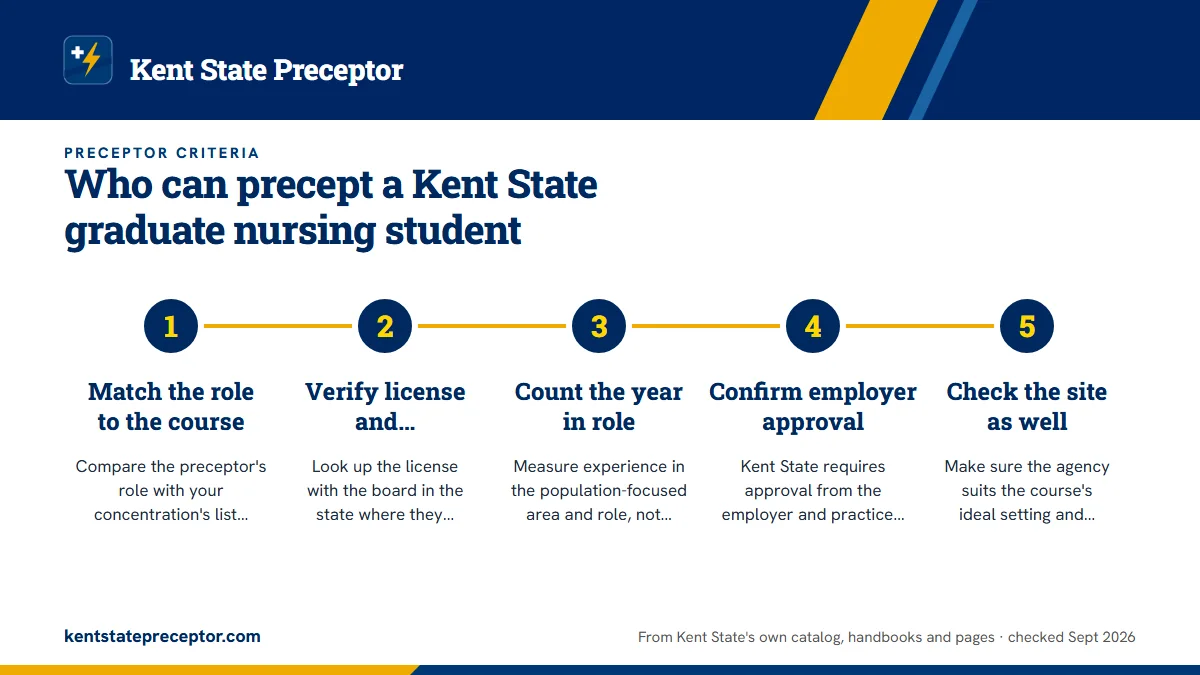
- Match the role to the courseCompare the preceptor's role with your concentration's list and the specific practicum course, not just the program.
- Verify license and certificationLook up the license with the board in the state where they practice, and confirm the certification covers your population focus.
- Count the year in roleMeasure experience in the population-focused area and role, not total years in health care.
- Confirm employer approvalKent State requires approval from the employer and practice setting, so ask the preceptor who signs off at their site.
- Check the site as wellMake sure the agency suits the course's ideal setting and either holds or can obtain an affiliation agreement with the college.
Why students trust us with preceptor vetting
Vetting decides whether a placement holds, and it is where we put the most care. Each preceptor we bring you has already been measured against Kent State's baseline and your concentration's own conditions, from the PMHNP prescriber requirement to the AGPCNP cap of 40 hours in any one specialty, before the name leaves our desk.
We collect what faculty will look at: credentials, license, a profile of the site and its onboarding steps, plus whether the facility already works with the college under an agreement. Practicum faculty and your coordinator make the approval decision, and we hand them a submission with nothing missing. For concentrations that need several preceptors, we plan the full sequence, not only the next course. Start with the form below.
Questions Kent State students ask
Can a physician assistant precept a Kent State NP student?
Generally, yes. Kent State lists physician assistants among accepted graduate preceptor roles, provided the license, experience and employer-approval conditions are met. Concentration rules can narrow this: the AGPCNP rotation page opens the door to a CNS or PA preceptor once faculty agree, while the fourth PMHNP practicum needs a PMH APRN covering half or more of its hours.
Can a new nurse practitioner precept me?
Only after a full year. Kent State sets a floor of one year in clinical practice, and the APRN rotation pages want that year spent in the population focus and role you are training for. An NP with long RN experience but under a year as an NP falls short. Check borderline cases with practicum faculty before you ask.
Can my own manager precept me at my workplace?
Kent State publishes no rule on supervisors, so ask practicum faculty first. The published limits vary by concentration: the PMHNP rules exclude your workplace outright, and NAHSL guidance steers you toward a site beyond your home unit or employer. Our page on using your workplace as a practicum site covers how to make it count.
What does a Kent State preceptor do before the semester?
They get a current CV to your graduate faculty member and clear the placement with their employer. When the term starts, the faculty member assigned to you sends them contacts, links, syllabi and a Typhon guide for preceptors. A clinician new to Kent State can read our page for those who precept a Kent State student.
Who can precept a Kent State Nurse Educator student?
A seasoned nurse educator based in an academic setting or a staff-development department. The concentration pairs a specialty practicum, NURS 67092, with the educator-role practicum, NURS 60592, which the catalog frames as time with a veteran educator in academic or professional development work. According to the rotation page, planning with faculty begins in mid-February, one semester ahead.
Related pages
Last checked 2026-09-24
We check these pages against Kent State's own catalog, handbooks and program pages. Your MSN or DNP handbook, your syllabus, your practicum faculty and your concentration coordinator have the final word.
- Kent State College of Nursing: Become a Preceptor
- Kent State College of Nursing: Family NP clinical rotation descriptions
- Kent State College of Nursing: PMHNP clinical rotation descriptions
- Kent State College of Nursing: AGACNP clinical rotation descriptions
- Kent State College of Nursing: graduate preceptor guidebook
Kent State says the preceptor search is yours. We make it the fastest part of your practicum.
Tell us your Kent State concentration, where you live and which semester your next practicum starts. We find preceptors who fit the course and prepare everything your practicum faculty and coordinator review before they approve.
- Preceptors matched to the course: primary care for
NURS 61292, acute care forNURS 61092, psychiatric care forNURS 61592, women's health forNURS 66192 - Credentials, license and site details ready for your practicum faculty and coordinator
- In your own community, in Ohio or wherever you live and hold your RN license
Start your placement plan
Program, city and semester is all we need to begin.