Kent State licensure disclosures: where each nursing program meets or does not meet
Kent State Online's Programs Leading to Licensure page sorts each licensure program into two columns, MEETS and DOES NOT MEET. The DOES NOT MEET entries come down to six states plus American Samoa: California and New York for every listed program, Michigan and Pennsylvania for the AGCNS and the BSN, and Arkansas and New Hampshire for the post-master's certificates.
Get your placement plan
Tell us your Kent State program and where you live. A placement advisor replies with the preceptor and site options that fit your Kent State course.
How Kent State's disclosure table works
The disclosure lives on a Kent State Online page titled Programs Leading to Licensure. No revision date appears on it, and the results below are as of September 24, 2026. Each program row splits the listed jurisdictions into two columns, MEETS and DOES NOT MEET, and there is no third column for undetermined or pending states.
Five nursing rows appear. The MSN NP concentrations (AGACNP, AGPCNP, FNP, PNP, PMHNP and WHNP) share one row. The MSN Adult Gerontology Clinical Nurse Specialist has its own, as do the NP post-master's certificates, the AGCNS post-master's certificate and the pre-licensure BSN.
Keep the question the table answers separate from the enrollment question. The disclosure speaks to whether a program meets a state's requirements for licensure. Whether you can enroll in an online program while living in that state is a different list, covered on Kent State's approved states.
DOES NOT MEET, program by program
Because every listed jurisdiction falls in one column or the other, the short DOES NOT MEET lists tell the whole story.
| Program row | DOES NOT MEET | MEETS |
|---|---|---|
| MSN NP concentrations: AGACNP, AGPCNP, FNP, PNP, PMHNP, WHNP | California, New York, American Samoa | The other 53 listed jurisdictions |
| MSN Adult Gerontology Clinical Nurse Specialist | California, Michigan, New York, Pennsylvania, American Samoa | Every other listed jurisdiction |
| NP post-master's certificates | Arkansas, California, New Hampshire, New York, American Samoa | Every other listed jurisdiction |
| AGCNS post-master's certificate | Arkansas, California, Michigan, New Hampshire, New York, Pennsylvania, American Samoa | Every other listed jurisdiction |
| BSN (pre-licensure) | California, Michigan, New York, Pennsylvania, American Samoa | Every other listed jurisdiction |
Look closely at the certificate rows. The MSN NP concentrations meet requirements in Arkansas and New Hampshire, but the NP post-master's certificates do not. Kent State's table gives no reason for the difference, so a certificate applicant with plans in either state should ask before enrolling. The certificate options themselves are on post-master's certificates.
The six states, one by one
California and New York close every licensure row. Michigan and Pennsylvania sit next to Northeast Ohio, so they come up for students who expect to work across a state line after graduation. Arkansas and New Hampshire affect certificate students only.
| State | Rows marked DOES NOT MEET | Kent State online programs listed for residents |
|---|---|---|
| California | All five: MSN NP concentrations, MSN AGCNS, NP certificates, AGCNS certificate, BSN | RN-to-BSN only |
| New York | All five rows | None |
| Michigan | MSN AGCNS, AGCNS certificate, BSN | None |
| Pennsylvania | MSN AGCNS, AGCNS certificate, BSN | All seven lists, including the AGCNS |
| Arkansas | NP certificates, AGCNS certificate | Nurse Educator, NAHSL, RN-to-BSN |
| New Hampshire | NP certificates, AGCNS certificate | Nurse Educator, NAHSL, DNP, RN-to-BSN |
| American Samoa | All five rows | Not on the approved-states page |
The state guides add each board's details; see Pennsylvania and Michigan for the two neighbors.
Programs that have no row on the table
Four Kent State nursing programs are absent from the disclosure: the DNP, the RN-to-BSN, the Nurse Educator concentration and NAHSL. None of them leads to a new license. The catalog labels the Nurse Educator and NAHSL credentials optional, with no state requiring them, and RN-to-BSN students already hold the RN license they practice under.
The DNP deserves a closer look. Post-BSN students on the Practice Leadership route earn the MSN in an APRN concentration and national certification before continuing into DNP coursework, so the MSN NP or AGCNS row is the one that describes the license they will seek. Post-master's DNP students enter with the licenses they already hold, and the DNP adds no new one.
For all four, the list that shapes your plans is the approved-states list, since it decides where you can enroll and therefore where your practicum happens. The license you need for practicum is covered on RN license for practicum.
Two conflicts to settle before you rely on the table
The first conflict is about certainty. Kent State's APRN program pages say the college "has not yet made a determination" on licensure requirements outside Ohio, while the disclosure table gives definite MEETS and DOES NOT MEET answers. Both are public, and they cannot both be current. Ask the Office of Student Services which one reflects Kent State's position today, and keep the reply.
The second is about enrollment versus licensure. Pennsylvania is approved for online AGCNS enrollment, yet the MSN AGCNS does not meet Pennsylvania's requirements. In the other direction, the MSN NP concentrations meet requirements in 53 jurisdictions while the fully online NP programs enroll from 14 or 17 states.
One statement is steady across Kent State's documents: graduates of its APRN concentrations and certificates are eligible for national certification and for APRN licensure in Ohio, while any other state may layer on requirements of its own.
How to use the disclosure when you plan
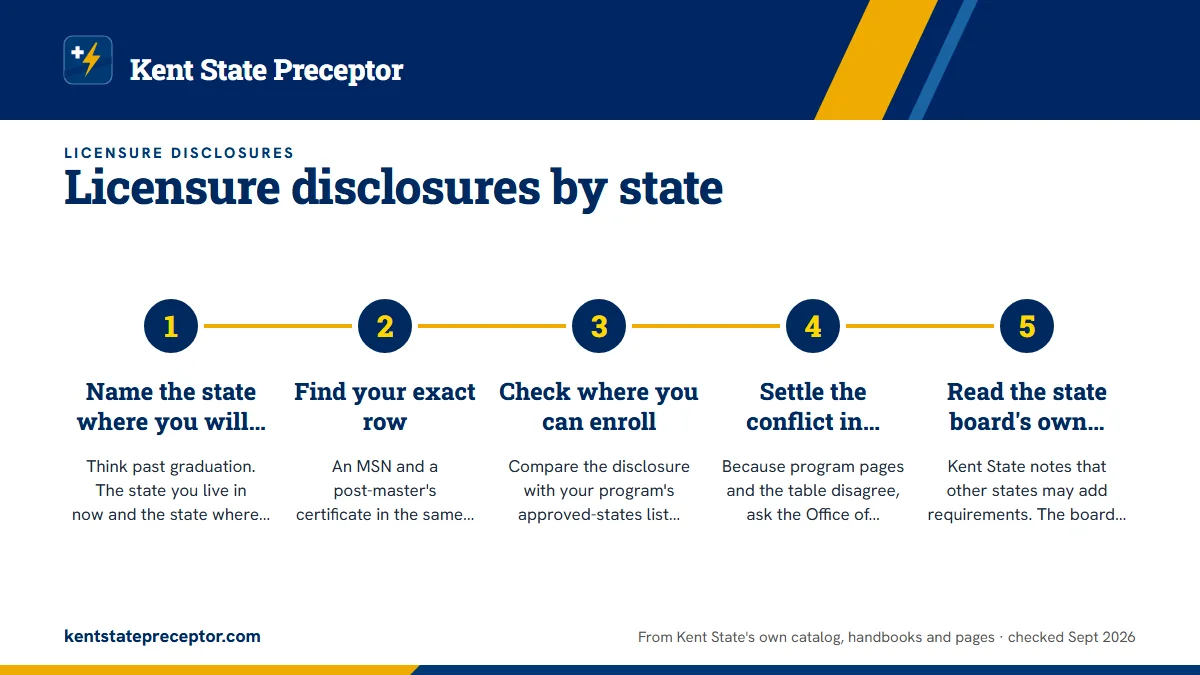
- Name the state where you will seek licensureThink past graduation. The state you live in now and the state where you plan to practice as an APRN may differ.
- Find your exact rowAn MSN and a post-master's certificate in the same specialty can have different results, as Arkansas and New Hampshire show.
- Check where you can enrollCompare the disclosure with your program's approved-states list for the state where you will live during the program.
- Settle the conflict in writingBecause program pages and the table disagree, ask the Office of Student Services to confirm the current position for your program and state.
- Read the state board's own rulesKent State notes that other states may add requirements. The board of nursing in the state where you will apply for licensure has the final word on what it accepts.
If your plans cross a state line, the clinicals outside Ohio page explains how practicum works in a host state.
How we keep your placement aligned with your plans
Kent State students choose us because we build every placement around the rules that shape your whole path, not just the next semester. We search for preceptors and sites in your home state, under the license you already hold there, which is also the state on your program's list, and we match the setting to what your Kent State course asks.
When you tell us where you expect to practice after graduation, we point you to the disclosure row and the state board early, so the question is settled long before your final practicum. Sites without a College of Nursing affiliation agreement are flagged at once so the college has time to set one up, and your placement file stays complete. Your concentration coordinator and practicum faculty decide on each preceptor and site, and the file we give them already lines up with Kent State's state and licensure rules. Reach us through the form below.
Questions Kent State students ask
Does Kent State's FNP lead to licensure in California or New York?
Kent State's disclosure table lists the MSN NP concentrations, the FNP included, as DOES NOT MEET for California, New York and American Samoa, and as MEETS for the other 53 listed jurisdictions. Program pages still say the college has not made a determination on out-of-state APRN licensure, so confirm the current position with the Office of Student Services before relying on either.
Why can I enroll in the AGCNS from Pennsylvania if it does not meet Pennsylvania's requirements?
The two Kent State pages answer different questions. The approved-states page lists Pennsylvania for online AGCNS enrollment; the licensure disclosure says the MSN AGCNS and the AGCNS certificate do not meet Pennsylvania's requirements. Kent State publishes no explanation for the pairing. A Pennsylvania resident weighing the AGCNS should raise it with the Office of Student Services and the Pennsylvania board before enrolling.
Why are the Nurse Educator and NAHSL programs missing from the disclosure?
They do not lead to a license. Kent State's catalog describes their credentials as optional and not required in any state, so there is no state licensure requirement to meet. You still need the right RN license for practicum, and your state still has to appear on the program's approved-states list for online enrollment.
Does the licensure disclosure apply to Kent State DNP students?
The DNP has no row of its own because it leads to no new license. Post-BSN students on the Practice Leadership route earn an MSN in an APRN concentration and national certification first, so the MSN NP or AGCNS row describes the license they will pursue. Post-master's DNP students keep practicing under the license they entered with.
What should I do if I plan to move to a DOES NOT MEET state after graduating?
Raise it before you enroll. Ask the Office of Student Services to confirm Kent State's current position for your program and that state, then read the state board of nursing's own requirements, since Kent State notes other states may add rules. Settling it early lets you weigh the program choice with the full picture.
Related pages
Last checked 2026-09-24
We check these pages against Kent State's own catalog, handbooks and program pages. Your MSN or DNP handbook, your syllabus, your practicum faculty and your concentration coordinator have the final word.
Kent State says the preceptor search is yours. We make it the fastest part of your practicum.
Tell us your Kent State concentration, where you live and which semester your next practicum starts. We find preceptors who fit the course and prepare everything your practicum faculty and coordinator review before they approve.
- Preceptors matched to the course: primary care for
NURS 61292, acute care forNURS 61092, psychiatric care forNURS 61592, women's health forNURS 66192 - Credentials, license and site details ready for your practicum faculty and coordinator
- In your own community, in Ohio or wherever you live and hold your RN license
Start your placement plan
Program, city and semester is all we need to begin.