Finding your own preceptor at Kent State: what the rule asks of you
Kent State puts the preceptor search in your hands. Graduate students identify qualified preceptors and confirm them with practicum faculty, yet real help is built in: your concentration coordinator assists in the term ahead of your first practicum, faculty and coordinators help after that, and the final approval belongs to them.
Hand us the preceptor search
Tell us your Kent State concentration, your city and the practicum course you need covered. Your placement advisor replies with how the search will run.
What the handbook rule says, word by word
The MSN Student Handbook AY 2025-2026 states it in one sentence: "Students are responsible for identifying qualified preceptors in appropriate practicum agencies and confirming with practicum faculty." Program FAQ pages for the online concentrations and the DNP say it more plainly still, calling the search primarily the student's responsibility.
Read the sentence as three separate jobs. Identifying means you bring a real candidate, not a wish list. Qualified and appropriate mean the person meets Kent State's preceptor criteria and the agency suits your course. Confirming with practicum faculty means nothing is settled until faculty agree.
The handbook also calls the choice a shared one among you, your faculty and the preceptor, with final approval resting with practicum faculty and the concentration coordinator. That applies to MSN, post-master's certificate and DNP students alike. Kent State's graduate preceptor guidebook lines up with it: securing a preceptor and site appears as a student duty, while helping with placement and confirming it with the preceptor and site appear as faculty duties.
How your coordinator and faculty help
Support arrives at two points. Ahead of your first practicum course, the concentration coordinator helps you locate a site and preceptor in the term just before that course starts. From then on, help comes as needed from course faculty and coordinators, and DNP students can also turn to the director of the DNP program.
The handbook's advising section describes a quieter kind of support too: coordinators or program directors, working with program faculty, help match preceptors and experiences to each course. In practice, they can tell you whether a candidate fits the course objectives before you spend weeks on agency onboarding.
Help is not a hand-off, though. Kent State's wording keeps you as the person who identifies the preceptor. The most useful thing you can bring your coordinator is a named preceptor, a named site and the exact course, so the conversation centers on approval instead of on where to begin.
The semester-before window
Coordinator help is pegged to the term ahead of your first practicum, and the required orientation arrives four to six months before that course. Taken together, those two anchors mean the real search opens roughly two terms ahead of your first practicum hours.
Picture a first practicum in Spring 2027, which begins Jan 19. The term before is Fall 2026, running Aug 24 to Dec 13, so that is when the coordinator's help applies. No hours may be logged before Jan 19 unless the coordinator agrees, yet a December meeting with your preceptor and agency onboarding are both fine.
Waiting for that window to open is an easy way to run short on time. Nothing Kent State publishes stops you from starting sooner, and an early start leaves room for an affiliation agreement if your site needs one. Our first practicum orientation guide turns the window into a month-by-month plan.
What counts as qualified and appropriate
Qualified describes the preceptor. Physicians, PAs, APRNs, healthcare administrators and Certified Nurse Educators can all precept, provided they meet Kent State's license, experience and employer-approval conditions, and several concentrations narrow the field further. The complete breakdown is on our preceptor requirements page.
Appropriate describes the agency, and it has three layers. The setting must fit what the course aims to teach and the ideal setting your concentration describes. The facility must be covered by an affiliation agreement with the College of Nursing that is in force before your hours count. And the agency's own rules for student requests apply, since some forbid students from contacting preceptors directly.
Location is the fourth quiet factor. Online students complete practicums face to face in their state of residence, where they hold a valid RN license, so your search is local even when your classes are not.
A search method built for Kent State's rules
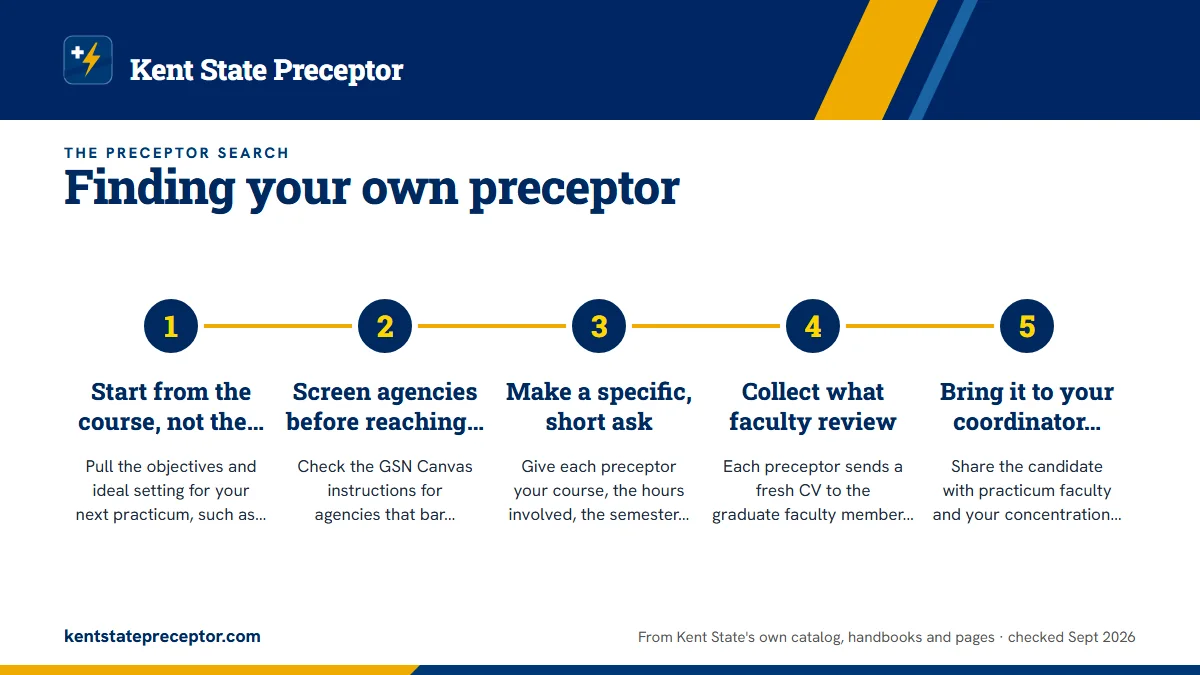
A focused search beats a wide one. These five moves keep each request aligned with what practicum faculty will later review.
- Start from the course, not the contact listPull the objectives and ideal setting for your next practicum, such as
NURS 61292for FNP and AGPCNP students, and note what the site must offer. - Screen agencies before reaching outCheck the GSN Canvas instructions for agencies that bar direct contact, and send any request to those agencies through their stated process.
- Make a specific, short askGive each preceptor your course, the hours involved, the semester dates and Kent State's criteria so they can answer quickly and accurately.
- Collect what faculty reviewEach preceptor sends a fresh CV to the graduate faculty member on your course and needs employer approval. Note license and certification details as you go.
- Bring it to your coordinator earlyShare the candidate with practicum faculty and your concentration coordinator, ask whether the site already has an agreement, and keep a backup in play.
Why one Kent State page sounds different
Kent State's Become a Preceptor page, written to recruit preceptors, describes the college matching students with preceptors and says every student is assigned both a preceptor and a faculty member. Read on its own, that sounds as if the school places everyone.
For graduate students, the MSN Student Handbook and the program FAQs govern, and both make the search primarily yours. The assignment language fits the BSN senior capstone, NURS 40045, where university and hospital faculty and staff do assign RN preceptors.
If you are unsure which description applies to you, ask your concentration coordinator directly and plan as if the search is yours until you hear otherwise. That plan loses nothing if extra help arrives, and it can save a whole term if it does not.
Why Kent State students hand the search to us
Kent State asks you to identify a qualified preceptor. We carry that legwork for you, thoroughly: we comb your own community for preceptors and sites that fit your specific Kent State course, confirm each one's willingness and availability for your semester dates, and screen them against the criteria for your concentration.
You get a candidate you can bring to practicum faculty with confidence, along with the details they review: credentials, license, site information and the agency's onboarding requirements. If a site has no agreement with the college yet, you hear it from us first, while there is still time to arrange one. Faculty and your coordinator make the final call, and our part is making that call easy. See how it works or share your concentration and term in the form below.
Questions Kent State students ask
Can my concentration coordinator help after my first practicum?
Yes, as needed. The coordinator's formal search help is tied to the term before your first practicum course. After that, support comes on request from course faculty and coordinators, plus the DNP program's director for doctoral students. Bring a specific problem, such as a preceptor who withdrew or a site that lacks an agreement, and the help you get will be sharper.
Can I use a preceptor I already know or work with?
Often, if they meet the criteria. Kent State publishes no rule on relatives or direct supervisors. The published limits are narrower: the PMHNP rules exclude the place you work, and NAHSL students are urged to step outside their home unit or employer. Practicum faculty decide, so disclose any existing relationship when you submit the preceptor.
Do I need a different preceptor for each practicum course?
Kent State sets no blanket rule, but concentration rules often force a change. A PMHNP student moves from a psychotherapy-focused provider to a prescriber between the first two practicums, the AGACNP final practicum covers two or three unfamiliar specialties, and AGCNS students plan on at least two agencies. Map each course's needs before asking one preceptor to cover several.
What if I cannot find a preceptor before the semester starts?
Tell your concentration coordinator and practicum faculty as early as you can, because hours must fall inside the semester and cannot start early without coordinator approval. Ask whether a different site or a backup preceptor could still work for the term. Our page for when you can't find a preceptor walks through the options step by step.
Do online Kent State students search in Ohio?
Only if they live in Ohio. Online students complete practicum courses in person in their home state, where they hold a valid RN license, provided that state is approved for their program. Kent State's 750+ clinical partners sit mostly in Northeast Ohio, which helps Ohio residents most, so students elsewhere build their search around local health systems and clinics.
Related pages
Last checked 2026-09-24
We check these pages against Kent State's own catalog, handbooks and program pages. Your MSN or DNP handbook, your syllabus, your practicum faculty and your concentration coordinator have the final word.
Kent State says the preceptor search is yours. We make it the fastest part of your practicum.
Tell us your Kent State concentration, where you live and which semester your next practicum starts. We find preceptors who fit the course and prepare everything your practicum faculty and coordinator review before they approve.
- Preceptors matched to the course: primary care for
NURS 61292, acute care forNURS 61092, psychiatric care forNURS 61592, women's health forNURS 66192 - Credentials, license and site details ready for your practicum faculty and coordinator
- In your own community, in Ohio or wherever you live and hold your RN license
Start your placement plan
Program, city and semester is all we need to begin.