The Kent State clinical placement process, from state check to final evaluation
Every Kent State graduate practicum runs through the same chain: confirm your state and license, learn the GSN Canvas course, attend orientation, find a preceptor, clear the affiliation agreement, earn approval, finish compliance and onboarding, then log hours in Typhon and close with evaluations. Here is the full order, who acts at each step, and where students lose time.
Map your Kent State practicum path
Tell us your concentration and the term your next practicum starts. Your placement advisor replies with where you stand and what to line up first.
How the Kent State graduate path is built
Kent State splits the work between you and the college. The MSN Student Handbook AY 2025-2026 makes identifying a qualified preceptor your job, treats the choice as shared among student, faculty and preceptor, and gives final approval to your practicum faculty and concentration coordinator. MSN, post-master's certificate and DNP students all work under that rule.
Think of the path as three phases. Eligibility checks come first and can be finished months ahead. The search and approval stretch follows, and most delays begin there. The term itself comes last, when hours, logs and evaluations run on fixed clocks. Each practicum course repeats phases two and three, so an AGACNP student with four practicums walks that loop four times.
Much of the fine print, the Graduate Student Guide for Practicum Placements among it, sits inside the GSN Canvas course. Because that course is behind login, this page tells you what lives there rather than quoting it.
Phase one: checks to finish before you search
Start here even if your first practicum is a year away. None of these steps needs a preceptor, and each can stall a placement if it surfaces late.
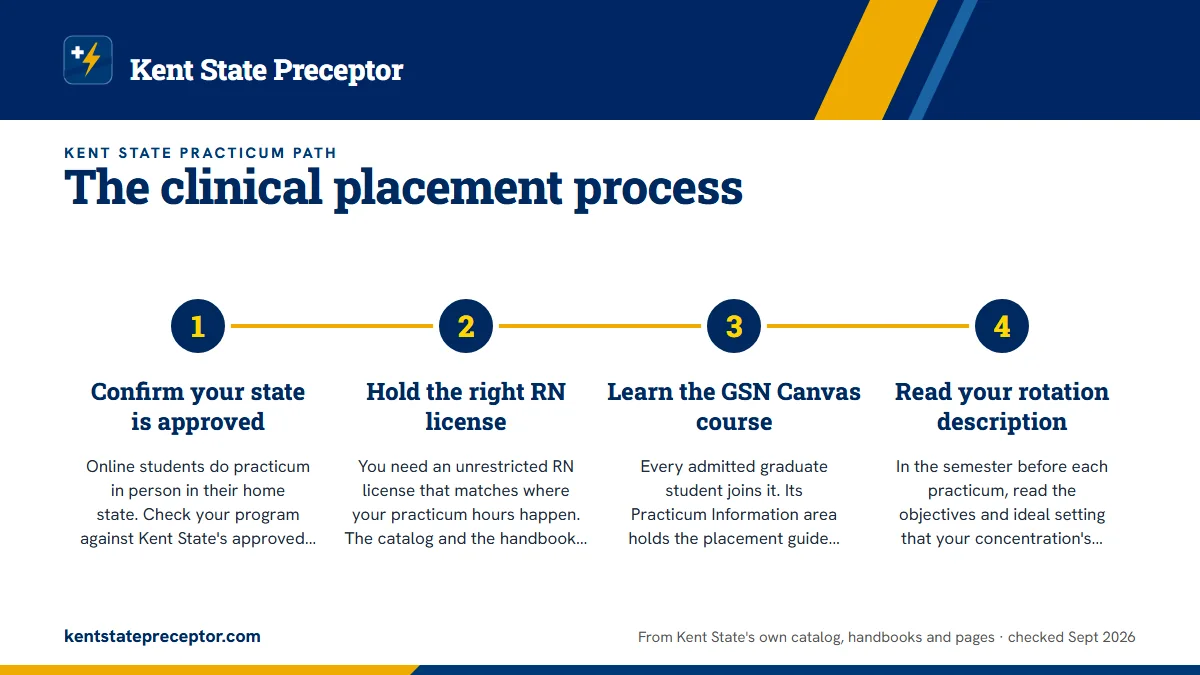
- Confirm your state is approvedOnline students do practicum in person in their home state. Check your program against Kent State's approved states for online nursing, and let the Office of Student Services know before any planned move.
- Hold the right RN licenseYou need an unrestricted RN license that matches where your practicum hours happen. The catalog and the handbook set different deadlines for proof, so settle the timing early with the college's Office of Academic Advising and Student Services.
- Learn the GSN Canvas courseEvery admitted graduate student joins it. Its Practicum Information area holds the placement guide, search instructions and compliance deadlines.
- Read your rotation descriptionIn the semester before each practicum, read the objectives and ideal setting that your concentration's Clinical Rotation Descriptions page lists for the course.
Phase two: orientation, search and approval
You control this stretch least, so give it the most lead time. The agreement and faculty approval decide whether your hours count.
- Attend the mandatory orientationYour concentration coordinator announces it, and it falls four to six months ahead of the opening practicum course. Our first practicum orientation plan turns that window into a monthly timeline.
- Identify a preceptor and siteThe search is yours, with coordinator help during the semester before your first practicum. Our guide to finding your own preceptor shows how that support works.
- Match Kent State's preceptor criteriaCheck each candidate against the baseline and concentration rules in Kent State preceptor requirements before sending a name for review.
- Respect agency contact rulesSome agencies bar students from reaching preceptors directly. Read the instructions for no-direct-contact agencies in GSN Canvas before any outreach.
- Confirm the affiliation agreementYour hours need a site covered by a current College of Nursing affiliation agreement. New agreements are negotiated by the college with the facility, and Kent State publishes no lead time.
- Earn final approvalPracticum faculty and your concentration coordinator approve the preceptor and site. Practicum courses also need special approval before you can register.
Phase three: getting cleared for day one
Compliance comes before registration. You must be fully compliant with Kent State's Clinical Compliance Policy before you register for the first practicum course, and no hours count while an item such as your yearly TB test or your flu shot is out of date.
Agency onboarding follows the site's own checklist, often including record-access training. Meeting your preceptor and finishing onboarding before the semester opens are both allowed.
Two smaller items close this phase: order the College name badge through GSN Canvas, then set up Typhon, which charges a one-time fee at first login, and enter the schedule you build with your preceptor.
Hours may not begin ahead of the term's opening day unless your coordinator approves, and every hour must be finished by the term's final day. For Fall 2026 that window is Aug 24 to Dec 13; for Spring 2027 it runs Jan 19 to May 9.
During the term: logs, absences and evaluations
Once hours begin, three clocks run at once. Time logs and case logs go into Typhon within 15 days of each practicum day. An absence needs a makeup plan reported to both your preceptor and your faculty. A clinical incident needs an incident report filed as soon as possible.
At 75 practicum hours per credit, a 2-credit practicum means 150 hours, or about 10 contact hours a week across the semester. Your preceptor's schedule sets yours, so a lost week is hard to recover near the end of the term.
Evaluations close the course. Your preceptor submits the final evaluation in Typhon, and you evaluate both the preceptor and the site while faculty review the logs. Your preceptor's verdict goes on file without setting the course grade alone, while conduct failures at a practicum site can earn an F for the whole course.
Who acts at each step
Knowing who owns a step tells you whom to ask when it stalls.
| Step | Who acts | Where it lives |
|---|---|---|
| State eligibility | You; the Office of Student Services if you move | Approved States for Online Learning page |
| RN license | You; the Office of Academic Advising and Student Services verifies it | Catalog and MSN Student Handbook |
| Orientation | Concentration coordinator sends notice | Coordinator notice; GSN Canvas orientation module |
| Preceptor search | You, with coordinator help before the first practicum | Graduate Student Guide for Practicum Placements |
| Affiliation agreement | College of Nursing with the facility | Not public; ask practicum faculty |
| Final approval | Practicum faculty and concentration coordinator | Your practicum course |
| Compliance | You, through the college's tracking vendor | Catalog Clinical Compliance Policy |
| Hours and evaluations | You, your preceptor and practicum faculty | Typhon |
For DNP students, the DNP program director also helps with preceptors, and a Project Chair oversees project hours.
Where the process usually stalls
Most delays come from steps that run on someone else's calendar. A new site's affiliation agreement is the biggest, because no lead time is published and your hours stay uncounted until it is current.
Concentration rules catch students next. A PMHNP student needs a psychotherapy-experienced mental health provider for Practicum I and a prescriber for Practicum II, so one preceptor rarely covers the sequence. An AGACNP final practicum spans two or three unfamiliar specialties of at least 50 hours each.
Compliance lapses are the quiet third. An immunization that expires mid-term halts your hours until it is renewed, even with an approved preceptor waiting.
A willing preceptor is only the start: your hours count once faculty and coordinator approval, a current affiliation agreement and full compliance are all in place.
Why Kent State students choose us for this path
We are built around this exact sequence. We search for a preceptor and practicum site that fit your Kent State course, in person in your own community, and test each candidate against Kent State's rules before you put a name forward.
We assemble the file your reviewers expect: proof of the preceptor's credentials and license, a profile of the site and a note of each agency's onboarding steps. Any site without a College of Nursing agreement gets flagged on day one, giving the college the longest possible runway to put one in place.
Approval stays with Kent State faculty and your coordinator; our work is making sure their review starts from a full, rule-ready file. If a preceptor drops mid-course, we stay on call and start the replacement search at once.
Questions Kent State students ask
How long does the Kent State clinical placement process take?
Kent State publishes no single timeline, but its fixed points add up. The orientation lands four to six months ahead of practicum one, coordinator help arrives the term before, and compliance must be finished before you register. New affiliation agreements have no published lead time, so begin searching about two terms ahead.
Do I repeat the whole process for every practicum course?
Most of it. Each practicum course needs an approved preceptor and site with a current affiliation agreement, its own Typhon logs and its own evaluations, and your compliance items must stay current the whole time. The mandatory orientation and the coordinator's formal search help are tied to the first practicum; after that, course faculty and coordinators help as needed.
Is the process different for Kent State DNP students?
The shape is similar, with different people involved. Locating a preceptor is still primarily your job, with faculty support and help from the DNP program director, and a Project Chair oversees your project hours. Your project site can sit in your home state, where you are licensed. Kent State lists no 2025-2026 DNP handbook, so confirm details with your advisor.
How does this compare with the BSN clinical process?
It is close to the reverse. Pre-licensure BSN and Accelerated BSN clinicals are scheduled Clinical Laboratory sections that the college arranges at local facilities. For the senior capstone, NURS 40045, university and hospital faculty and staff assign an RN preceptor to each student. Graduate students, by contrast, identify their own preceptors and submit them for approval.
Where do I find the Graduate Student Guide for Practicum Placements?
The guide is posted in GSN Canvas under Practicum Information, inside a course every admitted graduate student joins. Both the guide and the course are behind login, so their exact wording is not public. If the course or the guide is missing from your Canvas dashboard, ask your concentration coordinator to confirm your enrollment.
Related pages
Last checked 2026-09-24
We check these pages against Kent State's own catalog, handbooks and program pages. Your MSN or DNP handbook, your syllabus, your practicum faculty and your concentration coordinator have the final word.
Kent State says the preceptor search is yours. We make it the fastest part of your practicum.
Tell us your Kent State concentration, where you live and which semester your next practicum starts. We find preceptors who fit the course and prepare everything your practicum faculty and coordinator review before they approve.
- Preceptors matched to the course: primary care for
NURS 61292, acute care forNURS 61092, psychiatric care forNURS 61592, women's health forNURS 66192 - Credentials, license and site details ready for your practicum faculty and coordinator
- In your own community, in Ohio or wherever you live and hold your RN license
Start your placement plan
Program, city and semester is all we need to begin.