Kent State MSN AGPCNP: four adult primary care practicums in a 41-credit plan
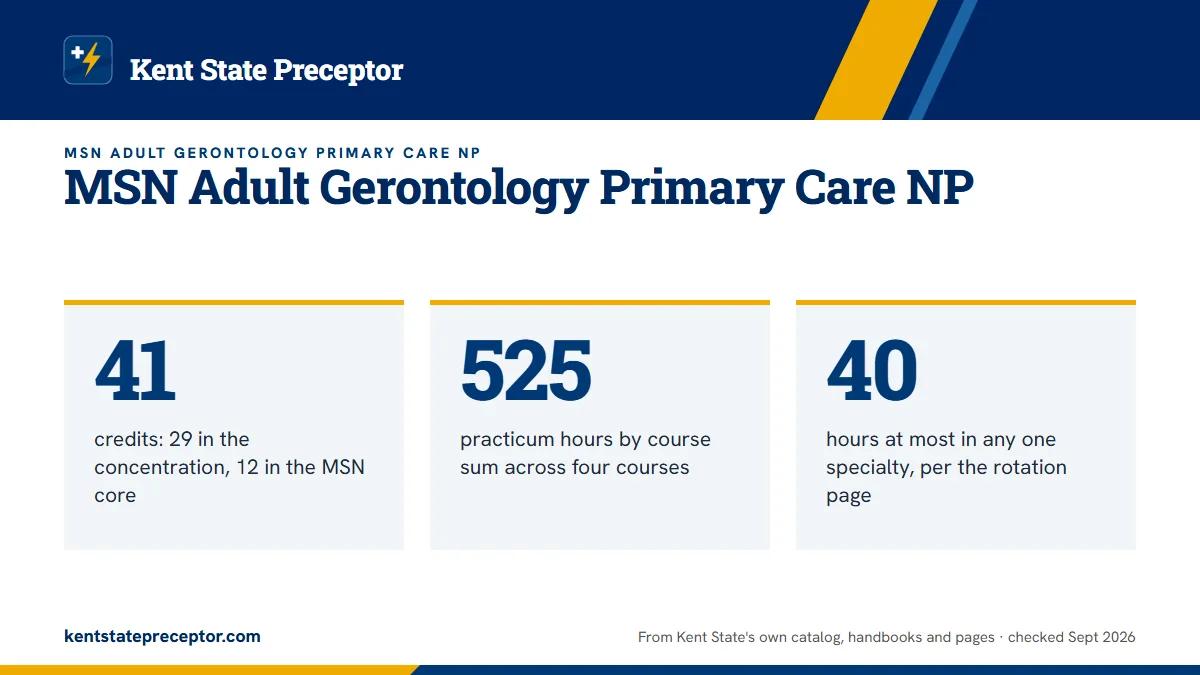
Kent State's Adult Gerontology Primary Care NP concentration keeps every practicum in adult and older-adult care: four courses adding up to 525 hours by course sum inside a 41-credit MSN. Three of those courses are shared with the FNP, and the fourth, NURS 63692, belongs to AGPCNP students alone.
Line up your adult primary care preceptors
Tell us your county and your next AGPCNP course. We search for internal medicine, primary care and long-term care preceptors who fit it.
What the AGPCNP degree involves
At 41 credits, the AGPCNP is six lighter than the FNP: 29 belong to the concentration and 12 to the shared MSN core. Its population is adults and older adults in primary care, so the plan carries no pediatrics practicum. Kent State lists fall and spring starts on the AGPCNP page.
The catalog places the AGPCNP among the mostly online concentrations, meaning at least half of the program is online and some courses require attendance at the Kent Campus. How many on-campus days there are, and in which courses, is not published. Ask your graduate advisor, and keep an Ohio RN license current for those campus courses.
No semester roadmap for the AGPCNP appears in the catalog; after admission, your sequence is set in GPS, Kent State's Graduate Planning System. Before any clinical course, you take the APRN foundation set: advanced health assessment, pathophysiology, pharmacology and clinical diagnostics.
Timing your first AGPCNP practicum
Your first clinical course is NURS 61292, the opening adult-gerontology primary care practicum, taken with the NURS 60120 lecture. It cannot start until NURS 60015 Advanced Health Assessment is behind you, and registration needs special approval and a completed Clinical Compliance Policy file. So the earliest first practicum is the term after health assessment.
Treat the notice for Kent State's mandatory first-practicum orientation, held 4 to 6 months ahead, as your start signal for the adult primary care search. In the term right before NURS 61292, your concentration coordinator also pitches in on that first placement. The finding your own preceptor guide explains how the coordinator's help sits alongside your own search, and why the preceptor must be confirmed with practicum faculty before any hours count.
The four AGPCNP practicums
The AGPCNP's four practicums follow a clear arc: a first primary care course, a short role course, a chronic illness course with specialty time, and a comprehensive final course. Each has a page of its own on this site.
| Practicum | Credits | Hours | Lecture it runs with | Shared with FNP? |
|---|---|---|---|---|
NURS 61292 AG Primary Care I | 2 | 150 | NURS 60120 | Yes |
NURS 61892 Family and AG NP Role | 1 | 75 | NURS 60125 | Yes |
NURS 62292 Primary Care II: Chronically Ill Adults | 2 | 150 | NURS 60220 | Yes |
NURS 63692 AG Comprehensive Primary Care III | 2 | 150 | NURS 60320 | No, AGPCNP only |
| Total by course sum | 7 | 525 |
Those 525 hours are our sum of the course descriptions, not a total Kent State prints for the AGPCNP. The sum sits comfortably inside the 300-to-600-hour range the catalog sets for MSN graduation, so the AGPCNP has none of the FNP's hour conflict. Each credit stands for 75 practicum hours, so the three 2-credit courses average about 10 hours a week over a 15-week semester and the role course about half that.
Preceptors for adult and older-adult care
Kent State's AGPCNP rotation page describes the usual preceptor as a nurse practitioner or physician in primary care, internal medicine, long-term care or express care. With faculty approval, a clinical nurse specialist or a physician assistant may also precept. Whoever precepts should have practiced for at least a year with adult-gerontology patients in that role.
Two AGPCNP rules shape the whole plan. You may spend no more than 40 hours with any single specialty, and each specialty preceptor needs faculty approval first. The summer practicum also includes at least 16 hours caring for underserved patients, so a safety-net site or a community practice belongs somewhere in your map.
The catalog's AGPCNP settings run from family practice and internal medicine offices to managed care, emergency departments, occupational health and long-term care. Your hours at any of them count only once the facility is under a current agreement with the College of Nursing.
Specialty blocks are capped at 40 hours each. A single cardiology or endocrinology practice cannot carry a whole course.
Where AGPCNP students can train and be licensed
Look for the AGPCNP on Kent State's online approved-states list and you will not find it, because that list covers only programs delivered fully online. No out-of-state enrollment rule for this concentration is published either. If you live outside Ohio, get a clear answer from Kent State's Office of Academic Advising and Student Services ahead of committing, and report any move right away; the clinicals outside Ohio page covers what host states can require.
Wherever you train, it is in person and under an unrestricted RN license for that state. For licensure, the three places Kent State marks as not meeting requirements for its NP master's concentrations are California, New York and American Samoa, and the AGPCNP falls under that row. Plan your career state with it in mind.
Certification and the DNP option
AGPCNP graduates can sit for the adult-gerontology primary care NP certification exam offered by either the ANCC or the AANP. The college describes its APRN concentrations as the route to APRN licensure in Ohio, noting that other states can layer on requirements of their own. As you finish, the concentration coordinator takes care of the certification and licensure forms.
The AGPCNP is also one of the APRN concentrations Kent State names for its BSN-entry DNP in Practice Leadership. On that route the first two years are the MSN, and DNP courses resume only after you hold the master's and national APRN certification. The BSN to DNP page covers that route.
Keep the three-year rule in view if you ever stop out. Every AGPCNP practicum, from NURS 61292 through NURS 63692, goes back on your plan with its lecture once it turns three years old, and graduation needs a 3.000 overall GPA.
Why AGPCNP students choose us
An AGPCNP plan carries two constraints that are easy to overlook: the 40-hour specialty cap and the underserved hours. We plan all four courses together: a primary care base for NURS 61292, a role-focused preceptor for the 75-hour course, specialty blocks for chronic illness that each stay within 40 hours, and a comprehensive final site.
Every candidate we bring you practices adult or older-adult care in person near your home. We verify each one's license, board certification and time in adult-gerontology practice, then package the approval details for your practicum faculty and coordinator, facility information included. Sites without an agreement are flagged at the start, giving the college room to put one in place.
When a preceptor leaves mid-course, tell us and the replacement search begins at once. To get started, send your county and next AGPCNP course through the form below.
Questions Kent State students ask
Is the Kent State AGPCNP the FNP without pediatrics?
Close, but not quite. The first three AGPCNP practicums are also FNP courses. From there the FNP picks up a children's practicum and a closing lifespan course, while the AGPCNP ends with its own comprehensive adult course, NURS 63692. The result is 41 credits and 525 hours by course sum for the AGPCNP, against 47 credits and 675 for the FNP.
May a PA serve as preceptor for Kent State AGPCNP hours?
Yes, with faculty approval. Kent State's AGPCNP rotation page names a nurse practitioner or physician as the usual preceptor and allows a clinical nurse specialist or physician assistant when faculty approve. Put the request to your practicum faculty before you commit, and have the PA's license and years in adult practice ready for their review.
Can AGPCNP hours be done in an emergency department?
The catalog lists emergency departments among AGPCNP practice settings, while the rotation page centers on internal medicine, primary care, express care and long-term care. Whether an emergency department fits a particular course depends on its objectives, so ask your practicum faculty first. Any specialty time also falls under the 40-hour cap.
How long is the Kent State AGPCNP program?
Kent State's catalog puts MSN study at four to five semesters full-time, or three to four years part-time, with six calendar years from admission as the outer limit. The AGPCNP's four practicums spread across that time according to your GPS plan, so check it for the term each clinical course falls in before you start your search.
Can I do AGPCNP practicum at my own long-term care facility?
Kent State publishes no workplace ban for the AGPCNP; the only outright ban is in the PMHNP. Whether your own facility can host a course is up to your practicum faculty and concentration coordinator. The facility would still need a College of Nursing agreement in place, and the preceptor a year or more in adult-gerontology practice.
Related pages
Last checked 2026-09-24
We check these pages against Kent State's own catalog, handbooks and program pages. Your MSN or DNP handbook, your syllabus, your practicum faculty and your concentration coordinator have the final word.
Kent State says the preceptor search is yours. We make it the fastest part of your practicum.
Tell us your Kent State concentration, where you live and which semester your next practicum starts. We find preceptors who fit the course and prepare everything your practicum faculty and coordinator review before they approve.
- Preceptors matched to the course: primary care for
NURS 61292, acute care forNURS 61092, psychiatric care forNURS 61592, women's health forNURS 66192 - Credentials, license and site details ready for your practicum faculty and coordinator
- In your own community, in Ohio or wherever you live and hold your RN license
Start your placement plan
Program, city and semester is all we need to begin.