How many clinical hours is Kent State's FNP program?
Add up the hours in the five Family Nurse Practitioner practicum course descriptions in Kent State's catalog and you get 675. The catalog's MSN graduation rule, written for every concentration at once, sets a floor of 300 to 600 clinical hours, depending on concentration. This page shows where each FNP hour comes from, why the two figures disagree, and who settles the number for your own plan.
Get your placement plan
Tell us your Kent State program and where you live. A placement advisor replies with the preceptor and site options that fit your Kent State course.
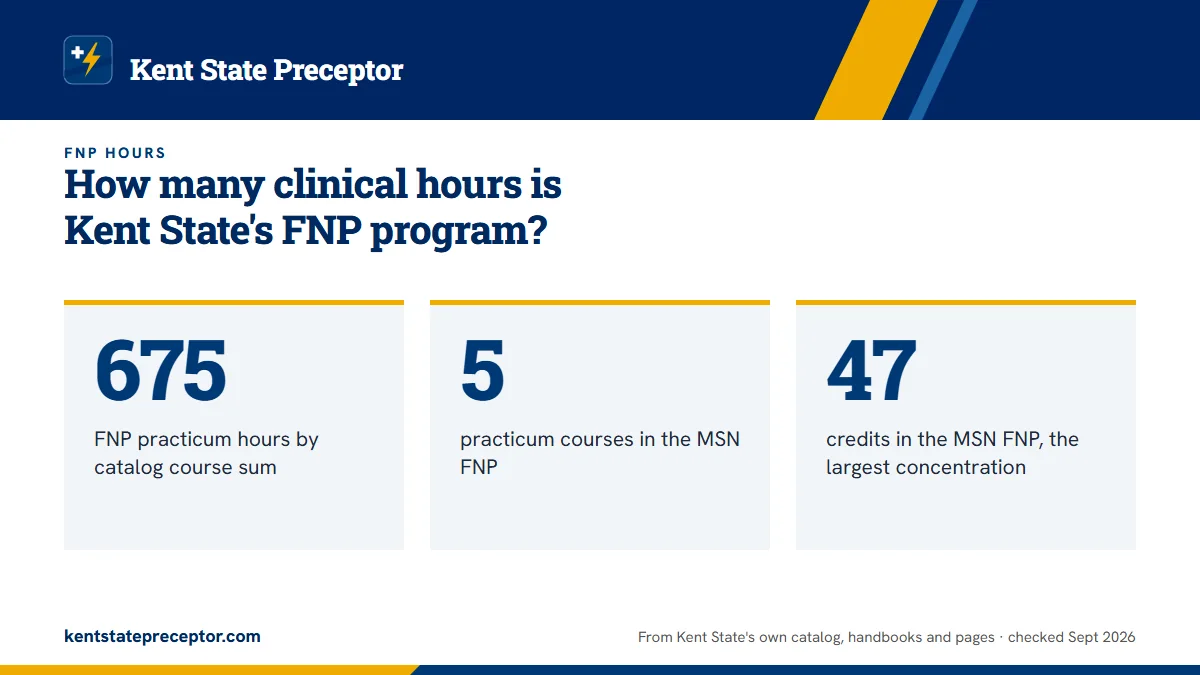
675 by course sum, 300-600 by the catalog rule
FNP students meet two numbers. The first is a sum you can check yourself: the 2026-2027 catalog prints an hour count in the description of each FNP practicum course, and the five courses total 675. The second is Kent State's own sentence on the MSN degree page, which requires a "Minimum 300-600 clinical hours, depending on concentration".
Both come from official Kent State pages, so neither is a rumor passed around a cohort. The course sum simply lands above the top of the stated range, which is why this question comes up more often from FNP students than from anyone else in the College of Nursing. The clinical hours hub compares every other concentration the same way.
Until someone with authority tells you otherwise, plan around the higher figure. The syllabus for each practicum, your practicum faculty and your concentration coordinator confirm what your own program plan requires. A preceptor booked for 150 hours is easy to release early. A preceptor booked for 75 when the course needed 150 leaves you searching again in the middle of the term.
Where the 675 hours come from, course by course
The MSN FNP has five practicum courses, and each one is taken alongside a lecture course. The hours below are the figures printed in each catalog course description; the last column names the paired lecture listed as its co-requisite.
| Practicum | Focus | Credits | Hours | Paired lecture |
|---|---|---|---|---|
NURS 61292 | Adult Gerontology Primary Care I Practicum | 2 | 150 | NURS 60120 |
NURS 61692 | Primary Care Pediatrics Practicum | 2 in the MSN (1-2 in the certificate) | 150 | NURS 60160 |
NURS 61892 | Family and Adult Gerontology NP Role Practicum | 1 | 75 | NURS 60125 |
NURS 62292 | Primary Care II Practicum: Chronically Ill Adults | 2 | 150 | NURS 60220 |
NURS 63292 | Primary Care: Family Health and Chronic Illness Practicum | 2 | 150 | NURS 60325 |
| Total | Five practicums | 9 | 675 | Course sum, not a printed requirement |
Three of these courses, NURS 61292, NURS 61892 and NURS 62292, are shared with the Adult Gerontology Primary Care NP concentration. The FNP then adds a pediatrics practicum and swaps the AGPCNP's final comprehensive course for its own family health practicum across the lifespan. The extra pediatrics course is why the FNP sum runs 150 hours past the 525 that the AGPCNP practicums add up to.
Why Kent State's FNP figures conflict
The 300-600 range is a single line on the MSN degree page, meant to cover nine concentrations from Nurse Educator to acute care. The FNP is the biggest of them at 47 credits, and it is the only one whose course descriptions total more than 600. A general rule and a detailed course list drifting apart happens in large catalogs; it still leaves you with a number to pin down.
Certificate students have a second wrinkle. The post-master's FNP certificate lists the pediatrics practicum as a 1-to-2-credit course, which lets a certificate plan hold either 75 or 150 pediatric hours. By course sum, a certificate total therefore lands anywhere from 600 to 675, depending on the load your gap analysis sets.
The MSN Student Handbook also says the college will email affected students about curricular changes such as new practicum-hour requirements. If your cohort received that kind of notice, it outranks anything on a public page, this one included.
Questions worth asking your concentration coordinator
- What practicum hour total does my GPS program plan require?
- Am I registered for
NURS 61692at 1 or 2 credits, and how many pediatric hours does that mean for me? - Does any syllabus set a minimum for one population, such as children or older adults, inside a course?
- If I finish a course's hours early, can extra hours move to the next practicum?
The mistake to avoid: treating 300-600 as your FNP target. Plan to the hours printed in each syllabus, and confirm the program total with your coordinator before you book preceptors.
The preceptors behind each block of hours
Hour totals matter because each block calls for a different kind of preceptor, and some blocks need two. Kent State's FNP clinical rotation descriptions set out who fits where:
- Adult and family practice hours: a physician, an FNP or an adult-gerontology NP.
- Pediatric hours in
NURS 61692: a pediatric NP, a pediatrician, or an FNP who mainly sees children. Pediatric specialty hours are not recommended. - Specialty blocks: cardiology and endocrinology rotations of roughly 35 to 40 hours each.
- The final lifespan course,
NURS 63292: a second site may be needed so you see every age group.
Every preceptor must also bring a year or more in the population focus and the role. Ratios, license rules and employer approval are on the preceptor requirements page. For course-level detail, read the guides to the pediatrics practicum and the family health practicum.
Planning 675 hours across your semesters
Kent State counts 75 practicum hours per credit, so a 2-credit FNP practicum is 150 hours, listed as 10 contact hours a week over a 15-week term. The 1-credit role practicum is half that. The hours-per-credit guide turns each load into a working week.
Every hour has to fall inside semester dates. Meeting the preceptor and completing agency onboarding can happen before the term; patient hours, though, begin on day one unless your coordinator approves an early start, and they finish by the semester's last day. Each practicum day then goes into Typhon within 15 days, as the Typhon page explains.
Five practicums mean five placements to arrange, and more once a pediatric preceptor or a second lifespan site joins the plan. Kent State describes the FNP as taking as few as two years full time or roughly three years while working, so most FNP students are lining up a preceptor for nearly every term. That rhythm, more than any single number, is what makes the FNP demanding to plan.
Why Kent State FNP students choose us for placements
Our service is built around this exact course sequence. We search for FNP preceptors in person, in your own community, matched to the practicum you are entering: an adult primary care practice for NURS 61292, a pediatric preceptor who meets the rotation rules for NURS 61692, and a lifespan practice, plus a second site when the ages call for it, for NURS 63292.
Each match comes with a packet built for the people who approve it, your practicum faculty and concentration coordinator: the preceptor's license and credentials, a profile of the practice and its onboarding steps. We check at the outset whether the practice already holds an affiliation agreement with the College of Nursing, so any new agreement can be arranged by the college in good time. Kent State keeps the final say, and our part is making sure the packet it reviews is whole and fits the rules on first review.
Should a preceptor leave partway through a course, we go straight to work on a replacement. Share your concentration, your next practicum course and your term on the contact page or in the form below.
Questions Kent State students ask
Does Kent State's FNP program require 675 clinical hours?
The five FNP practicum course descriptions in the 2026-2027 catalog add up to 675 hours. Kent State does not print 675 as one requirement, and its MSN degree page states a minimum of 300 to 600 hours depending on concentration. Treat 675 as the working figure and ask your concentration coordinator to confirm the total in your program plan.
How many pediatric hours do Kent State FNP students complete?
In the MSN FNP, NURS 61692 Primary Care Pediatrics Practicum is 2 credits and 150 hours. The post-master's FNP certificate lists the same course at 1 to 2 credits, so certificate students may complete 75 or 150 pediatric hours. Your syllabus and gap analysis settle which applies, and the preceptor should be a pediatric NP, pediatrician or pediatrics-focused FNP.
Does the Kent State FNP need more clinical hours than the AGPCNP?
Yes, by course sum. The AGPCNP practicums add up to 525 hours and the FNP practicums to 675. The two concentrations share three practicum courses; the FNP adds a pediatrics course and replaces the AGPCNP's final comprehensive course with a family health practicum across the lifespan. The AGPCNP program guide covers its own sequence in detail.
Can FNP clinical hours begin early?
Early starts need your concentration coordinator's sign-off. Otherwise hours open with the semester's first day and must wrap up by its last. You can still meet your preceptor and complete agency onboarding ahead of time, which saves days once the term opens. Fall 2026 classes span August 24 through December 13.
Can I do Kent State FNP clinicals outside Ohio?
The FNP is a mostly online, hybrid concentration, and it is missing from Kent State's Approved States for Online Learning page, which covers the fully online programs. Public sources leave out-of-state eligibility for the FNP unresolved. Check with Kent State's advising and student services office before planning any site outside Ohio, and read the approved states guide.
Related pages
Last checked 2026-09-24
We check these pages against Kent State's own catalog, handbooks and program pages. Your MSN or DNP handbook, your syllabus, your practicum faculty and your concentration coordinator have the final word.
- Kent State Catalog 2026-2027: Nursing M.S.N. (hour rule and concentrations)
- Kent State Catalog 2026-2027: College of Nursing course descriptions
- Kent State Catalog: Family Nurse Practitioner graduate certificate
- Kent State College of Nursing: Family NP clinical rotation descriptions
- Kent State College of Nursing: Family Nurse Practitioner program
Kent State says the preceptor search is yours. We make it the fastest part of your practicum.
Tell us your Kent State concentration, where you live and which semester your next practicum starts. We find preceptors who fit the course and prepare everything your practicum faculty and coordinator review before they approve.
- Preceptors matched to the course: primary care for
NURS 61292, acute care forNURS 61092, psychiatric care forNURS 61592, women's health forNURS 66192 - Credentials, license and site details ready for your practicum faculty and coordinator
- In your own community, in Ohio or wherever you live and hold your RN license
Start your placement plan
Program, city and semester is all we need to begin.