Agency onboarding before your first Kent State practicum day
Once your practicum faculty and concentration coordinator approve a site, the agency runs its own steps: record-access or charting training, confidentiality rules, its dress code and any checks it adds. Kent State lets you meet your preceptor and finish onboarding before the semester starts, and that early start is the surest way to protect your first weeks of hours.
Get your placement plan
Tell us your Kent State program and where you live. A placement advisor replies with the preceptor and site options that fit your Kent State course.
Where onboarding sits in the Kent State sequence
Agency onboarding comes near the end of the path. By the time an agency starts onboarding you, you have found a preceptor, confirmed the site holds a College of Nursing affiliation agreement, secured the final sign-off of your practicum faculty and concentration coordinator, and completed the Clinical Compliance Policy. Onboarding is the agency's turn: it decides what a student must finish before touching its records or its patients.
Two sets of requirements meet here. Kent State's are gathered in the Practicum Information area of the GSN Canvas course, which holds agency onboarding standards and compliance deadlines. The agency's own requirements arrive in its onboarding packet or straight from the agency.
| Item | Who sets it | When to expect it |
|---|---|---|
| Record-access or charting training | The agency, with Kent State requiring you to complete it | After approval; allowed before the semester starts |
| HIPAA confidentiality | Kent State and the agency | Before your first patient contact |
| Dress code | The agency, on top of Kent State's appearance rules | Ask at your first preceptor meeting |
| Extra background checks or drug screens | The agency | Named in the agency's packet |
| Typhon schedule | You and your preceptor | Once the dates are agreed |
| Clinical incident report | Kent State | As soon as possible after any incident |
Record-access and charting training
The MSN Student Handbook requires you to complete the agency's record-access training, and the student-role page of Kent State's preceptor guidebook folds charting training into onboarding. Until an agency grants you access to its electronic health record, much of a practicum day, from reviewing a chart to documenting a visit, has to wait.
The agency controls when training and access happen, which is why Kent State's permission to onboard before the semester is so valuable. A student who finishes training in the weeks before day one can spend the first scheduled shift with patients instead of in a training module.
Kent State publishes no graduate rule on whether onboarding time counts toward practicum hours. An older BSN capstone syllabus says time spent on agency drug screens, background checks or computer training does not count as clinical hours. For graduate courses, ask your practicum faculty before you log any onboarding time in Typhon, and plan as if it will not count.
HIPAA and confidentiality
Confidentiality is a Kent State rule before it is an agency rule. The MSN Student Handbook lists HIPAA confidentiality among practicum expectations, and the 2015 university template for affiliation agreements includes a student waiver and confidentiality statement that records HIPAA training. Your agency may add its own confidentiality training and statement, so expect to sign whatever it asks.
In practice the rule reaches well beyond the chart. Patient details stay at the agency: out of the notes you carry home, out of messages to classmates and out of discussion posts in your online courses. When you log case information in Typhon, follow the directions in your syllabus and the Graduate Student Guide for Practicum Placements, which is where Kent State points students for logging instructions.
Meeting your preceptor before day one
Kent State allows you to meet your preceptor before the semester starts, and that meeting repays the effort many times over. The preceptor's schedule sets yours, so the calendar you build together is the calendar you will work.
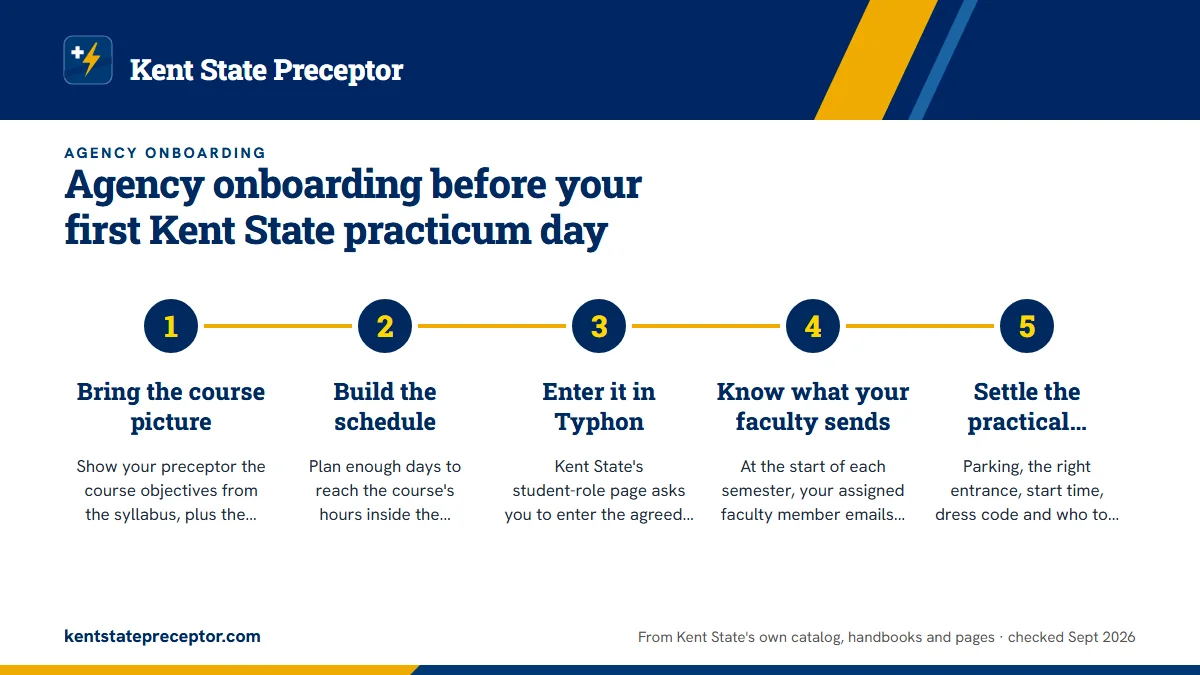
- Bring the course pictureShow your preceptor the course objectives from the syllabus, plus the description of an ideal setting that Kent State publishes for your practicum on the Clinical Rotation Descriptions pages of its preceptor guidebook.
- Build the schedulePlan enough days to reach the course's hours inside the semester. A 2-credit Kent State practicum carries 150 hours, about 10 contact hours a week, and some rotations ask for more, such as the 16 to 20 hours a week on the AGACNP rotation pages.
- Enter it in TyphonKent State's student-role page asks you to enter the agreed practicum days in Typhon so your faculty and preceptor see the same plan.
- Know what your faculty sendsAt the start of each semester, your assigned faculty member emails the preceptor contacts, links, syllabi and the Preceptor Guide to Typhon. Your preceptor, in turn, returns a current CV to that faculty member.
- Settle the practical detailsParking, the right entrance, start time, dress code and who to reach if you are delayed. Small answers now prevent a lost first morning.
If the agency bars students from contacting preceptors directly, the meeting runs through the agency's own channel; see no-direct-contact agencies.
Dress codes: the agency's and Kent State's
The agency's dress code governs what you wear on site, and it can differ a great deal from the rules at your own workplace. Kent State adds a short list that travels with you to every agency, from covered tattoos to unscented products, plus the College name badge; both are on the liability insurance and badge page.
Ask for the dress code at your first meeting, or in writing if the agency has one, and ask about the particulars: whether the unit expects scrubs or business clothes, whether a lab coat is expected, and which footwear is allowed. A leadership or educator practicum often sits in an office setting with its own norms, so the question matters as much there as on a clinical unit.
RN-to-BSN students follow each agency's uniform policy, as their handbook states.
Absences, incidents and the reports Kent State expects
Two reporting rules in the MSN Student Handbook apply from your first day. If you will miss a scheduled practicum day, report the absence and your plan to make it up to both your preceptor and your practicum faculty. If an incident happens, file a clinical incident report as soon as possible, and follow the agency's own reporting steps as well.
The stakes are real. Missing hours without notifying your preceptor and faculty is a conduct failure, and conduct failures in a practicum can bring an F in the course regardless of other grades. What a failing practicum grade sets in motion is explained on graduate grades and probation.
Tell both people, every time. A message to your preceptor alone falls short of the handbook's absence rule.
Where we fit: onboarding mapped before you say yes
Kent State students choose us because we gather a site's onboarding needs at the same moment we confirm the preceptor. You see the agency's training steps, extra checks and dress expectations with the placement proposal, so onboarding holds no surprises after approval.
Any site that still lacks a College of Nursing affiliation agreement is flagged at the proposal stage, giving the college time to arrange one, and we help you set up the pre-semester meeting with your preceptor. If a preceptor drops, we stay on call and find a replacement. Approval rests with your practicum faculty and concentration coordinator; our part is a proposal thorough enough that onboarding can begin as soon as they sign off. Contact us or use the form below.
Questions Kent State students ask
Can I start agency onboarding before the Kent State semester begins?
Yes. The MSN Student Handbook allows meeting your preceptor and completing agency onboarding before the term. What needs your coordinator's approval is counting practicum hours before the first day of the semester. Fall 2026 classes begin August 24 and Spring 2027 classes begin January 19, so onboarding can fill the weeks before either date.
Does EHR training count toward my Kent State practicum hours?
Kent State publishes no graduate rule on it. An older BSN capstone syllabus says time spent on agency computer training, drug screens and background checks does not count as clinical hours. Ask your practicum faculty before logging any onboarding time, and build your schedule on the assumption that the course's full hour total still lies ahead once training ends.
What if the agency wants a drug screen Kent State did not ask for?
Complete it. Kent State's catalog compliance policy leaves drug screens out, but agencies can set their own, and the 2015 university template expects students to meet whatever screening a facility sets, drug tests included. Build it into your timeline, since results take time to come back; details are on the background checks page.
Who tells my preceptor what Kent State expects?
Your faculty member does. At the start of each semester, the assigned faculty member emails your preceptor contact details, links, syllabi and the Preceptor Guide to Typhon, and the preceptor returns a current CV to the same faculty member. You still bring the course objectives to your first meeting, so the schedule you build fits what the course asks.
What should I do if I am injured or exposed at my practicum site?
Follow the agency's immediate process first, then file Kent State's clinical incident report as soon as possible, as the MSN Student Handbook requires, and tell your practicum faculty. Coverage questions, including Kent State's practicum liability insurance and its substantial deductible, are explained on the liability insurance and badge page linked above.
Related pages
Last checked 2026-09-24
We check these pages against Kent State's own catalog, handbooks and program pages. Your MSN or DNP handbook, your syllabus, your practicum faculty and your concentration coordinator have the final word.
Kent State says the preceptor search is yours. We make it the fastest part of your practicum.
Tell us your Kent State concentration, where you live and which semester your next practicum starts. We find preceptors who fit the course and prepare everything your practicum faculty and coordinator review before they approve.
- Preceptors matched to the course: primary care for
NURS 61292, acute care forNURS 61092, psychiatric care forNURS 61592, women's health forNURS 66192 - Credentials, license and site details ready for your practicum faculty and coordinator
- In your own community, in Ohio or wherever you live and hold your RN license
Start your placement plan
Program, city and semester is all we need to begin.