Kent State nursing background checks: BCI, FBI and agency add-ons
Kent State's Clinical Compliance Policy requires federal and state criminal background checks before your first practicum course. For BSN students that means an Ohio BCI&I check and an FBI check, fingerprinted at a Fast Fingerprint site. Practicum agencies can then layer their own screening on top, including yearly rechecks and drug screens.
Get your placement plan
Tell us your Kent State program and where you live. A placement advisor replies with the preceptor and site options that fit your Kent State course.
What Kent State's policy requires
The College of Nursing's Clinical Compliance Policy, published in the 2026-2027 catalog, lists federal and state criminal background checks among its required items. The rule reaches every College of Nursing student headed for clinical work, BSN, MSN, DNP and certificate students alike, and the checks have to be finished ahead of your first practicum registration.
Results are held by the college's third-party tracking vendor, and students pay for the checks. Screening is one piece of a larger set that also includes CPR, health insurance, immunizations and a physical; the Clinical Compliance Policy page walks through all of it.
Graduate practicum courses also need special approval to register. Since compliance is a condition of registering, a check still being processed when registration opens holds up the course itself. That is why screening belongs near the top of the list, well ahead of the term.
BCI and FBI: the two checks
The BSN handbook spells out the two checks Kent State relies on. Graduate documents use the same federal-and-state wording without walking through the steps.
| Check | Covers | How it is done |
|---|---|---|
| BCI&I | Ohio criminal records (the state check) | Fingerprints taken at a Fast Fingerprint location |
| FBI | Federal criminal records | Fingerprint-based, per the BSN handbook's instructions |
Both checks begin with fingerprints, so plan an in-person visit to a Fast Fingerprint location rather than expecting an online form alone. The BSN handbook adds that vendor records may be shared with clinical sites. Graduate students should take their check instructions from the GSN Canvas course or from the college's advising and student services office, because the graduate vendor and its steps are not described in public documents.
BSN, graduate and RN-to-BSN students
The screening rule is shared across the College of Nursing. What differs is the paperwork and the trigger.
- BSN and Accelerated BSN: BCI&I and FBI checks, tracked in Castlebranch. Clinicals are school-arranged, so the checks follow you through the rotations the college schedules, subject to any agency recheck. See BSN clinicals.
- MSN, post-master's certificate and DNP: federal and state checks under the same catalog policy, tracked by a vendor Kent State leaves unnamed in public documents. Because your site changes from one practicum to the next, each new agency may ask for its own screening.
- RN-to-BSN: the handbook calls for background checks only when a site asks for one. The RN-to-BSN guide covers the rest of that program's clinical rules.
Whichever group you are in, keep copies of your results and the dates they were run. That makes it quick to answer when a new agency asks about your screening.
Agency add-ons: rechecks, drug screens and more
Kent State's policy sets the floor, and practicum agencies can go further. The BSN handbook notes that some agencies want background checks repeated every year. The BSN capstone syllabus lists drug screens, background checks and computer training among the requirements some agencies set, and says that time does not count toward clinical hours.
A drug screen is not one of the catalog's compliance items. It shows up only where an agency requires it. Kent State's 2015 template affiliation agreement requires students to complete whatever background screening or drug testing a facility asks for, plus a negative TB result from the past 12 months and HIPAA training.
Marijuana deserves its own mention. The MSN Student Handbook tells graduate students not to use it because Kent State's clinical partners prohibit it. Treat that as a firm rule for the whole program, since any agency can add a screen.
The mistake to avoid: assuming one Kent State check satisfies every agency. Ask each new site what it adds before your start date, so a recheck or screen is not waiting for you in week one.
Living or doing practicum outside Ohio
The policy calls for a federal check and a state check. Kent State's public documents name Ohio's BCI&I for BSN students, whose clinicals are arranged around Kent State's Ohio campuses, but they do not say which state check an online graduate student living elsewhere completes. Check with Kent State's advising and student services office before ordering anything, so you pay for the right check once.
Agencies outside Ohio set their own onboarding, just as Ohio agencies do, and SARA membership does not cover nursing board rules. The clinicals outside Ohio page covers host-state approval and what happens when you move.
If you move after admission, Kent State requires you to notify the Office of Student Services at once. Ask in the same conversation whether your background checks need to be redone for the new state.
Timing your checks
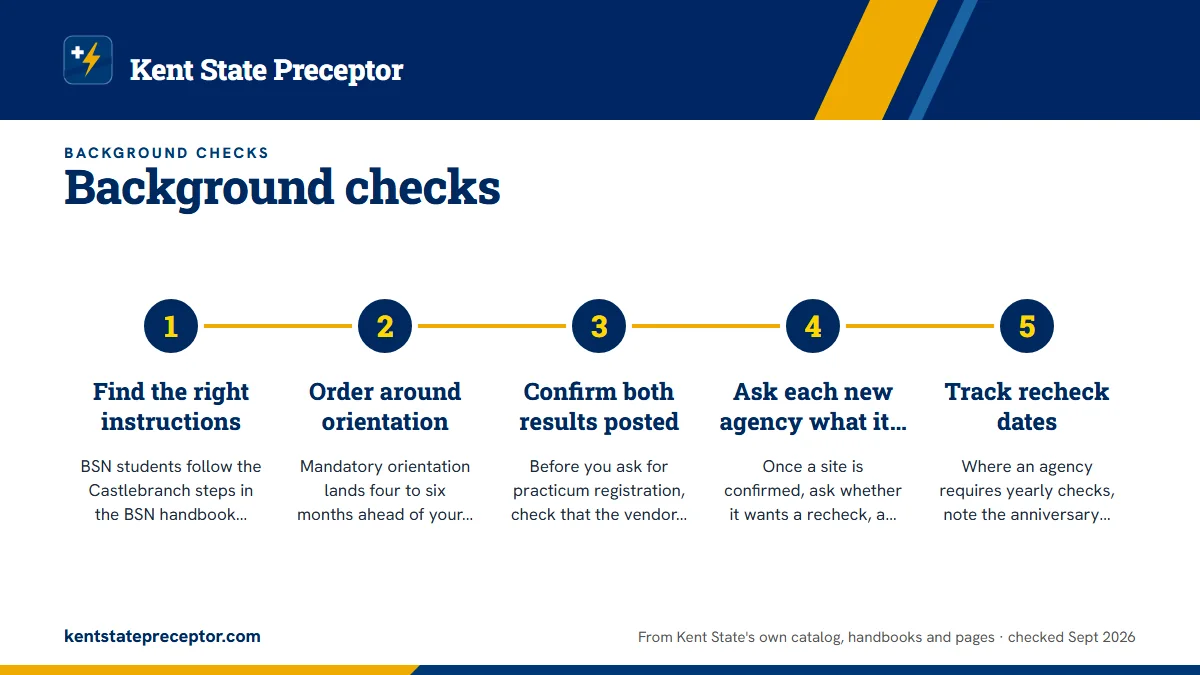
- Find the right instructionsBSN students follow the Castlebranch steps in the BSN handbook. Graduate students look under Practicum Information in the GSN Canvas course, or ask student services.
- Order around orientationMandatory orientation lands four to six months ahead of your first practicum. Ordering checks then leaves room for results and any follow-up.
- Confirm both results postedBefore you ask for practicum registration, check that the vendor shows the state and federal results, not just the order.
- Ask each new agency what it addsOnce a site is confirmed, ask whether it wants a recheck, a drug screen or its own form, and how far ahead of your start.
- Track recheck datesWhere an agency requires yearly checks, note the anniversary and renew before it passes.
Why Kent State students choose us
Screening surprises are avoidable when the site is known early. Once we have a preceptor and practicum site lined up near your home, we ask the agency what it expects beyond Kent State's policy, including rechecks, drug screens and onboarding training, and pass that along before your start date.
The approval decision rests with your practicum faculty and concentration coordinator, and we hand them a full picture: the preceptor's license and credentials, a description of the site, and the agency's own onboarding list. We also check up front whether the agency has an affiliation agreement with the College of Nursing, and if a preceptor drops, we stay with you until a replacement is in place. Reach us through the contact page.
Questions Kent State students ask
Does Kent State nursing require an FBI background check?
Yes. Kent State's Clinical Compliance Policy requires federal and state criminal background checks. The BSN handbook names them as the Ohio BCI&I check and the FBI check, both fingerprint-based and done at a Fast Fingerprint location. Graduate students follow the same federal-and-state rule, with instructions through the GSN Canvas course or student services.
How often do Kent State nursing students redo background checks?
Kent State's policy asks for the checks before your first practicum course. According to the BSN handbook, some agencies require them again every year, so the real answer depends on your sites. Ask each agency about recheck timing when it confirms your placement, and keep a note of the date.
Is a drug test part of the Kent State nursing background check?
No. A drug screen is not in the catalog's Clinical Compliance Policy. Agencies may require one, and under Kent State's template affiliation agreement, a facility's drug-testing requirement falls to the student. The MSN handbook also bars marijuana use, because the college's clinical partners prohibit it.
Who pays for Kent State nursing background checks?
Students cover it. Under the catalog's Clinical Compliance Policy, every compliance cost falls to the student, background checks and the tracking vendor included. When an agency adds a screen of its own, ask the site and your practicum faculty how it is arranged. The placement costs page lists other costs to plan for.
Does time spent on background checks count as clinical hours?
The capstone syllabus for Kent State's BSN notes that agency requirements such as drug screens, background checks and computer training take time that is not counted as clinical hours. Graduate students should check their own syllabus. Either way, schedule screening outside your practicum days, since hours can only begin once the semester opens.
Related pages
Last checked 2026-09-24
We check these pages against Kent State's own catalog, handbooks and program pages. Your MSN or DNP handbook, your syllabus, your practicum faculty and your concentration coordinator have the final word.
- Kent State Catalog 2026-2027: College of Nursing (Clinical Compliance Policy)
- Kent State College of Nursing: BSN Handbook 2025-2026
- Kent State College of Nursing: MSN Student Handbook AY 2025-2026
- Kent State General Counsel: affiliation agreement template (2015)
- Kent State College of Nursing: NURS 40045 syllabus
Kent State says the preceptor search is yours. We make it the fastest part of your practicum.
Tell us your Kent State concentration, where you live and which semester your next practicum starts. We find preceptors who fit the course and prepare everything your practicum faculty and coordinator review before they approve.
- Preceptors matched to the course: primary care for
NURS 61292, acute care forNURS 61092, psychiatric care forNURS 61592, women's health forNURS 66192 - Credentials, license and site details ready for your practicum faculty and coordinator
- In your own community, in Ohio or wherever you live and hold your RN license
Start your placement plan
Program, city and semester is all we need to begin.