Kent State's online RN-to-BSN: the clinical course, the capstone and what comes next
Kent State's Nursing for Registered Nurses BSN is fully online, with no campus visits, and open to RNs in 30 approved states. Two courses carry the practice-based work: NURS 43001 Health Promotion, which includes a clinical laboratory, and the NURS 47099 capstone project. Kent State publishes no practicum-hour total, so each syllabus is your guide.
Plan your clinical and capstone work
Tell us your state, your start term and which course is coming up.
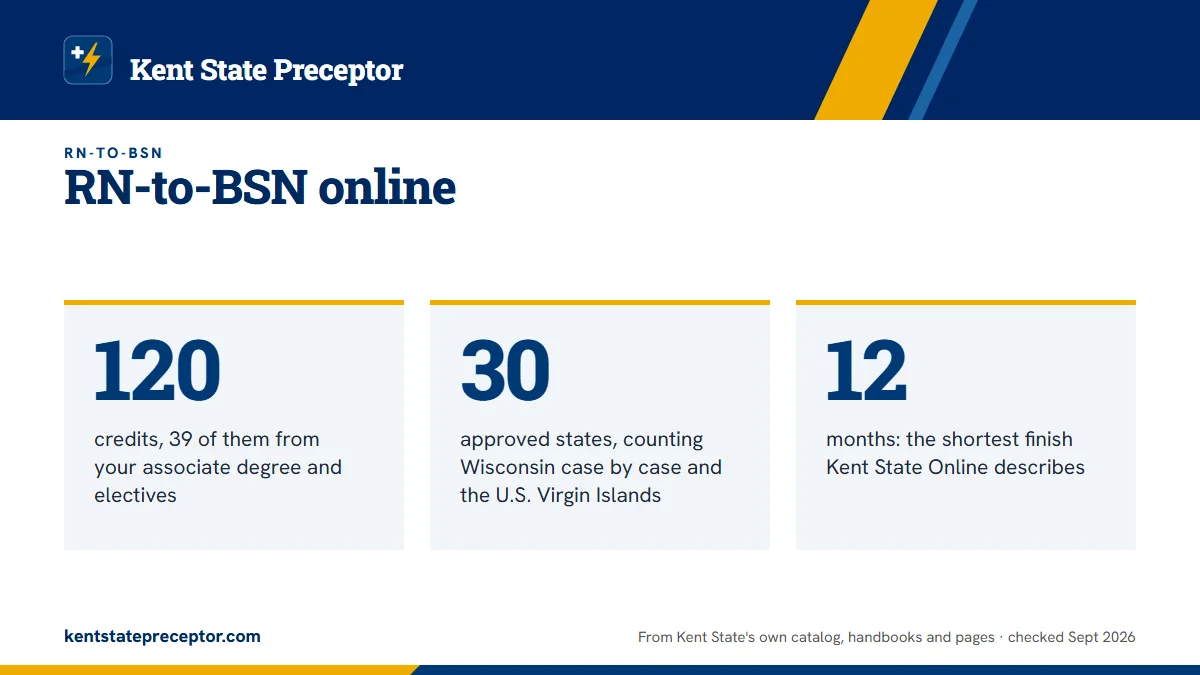
The RN-to-BSN plan at a glance
Kent State's catalog builds the degree to 120 credits, with 39 carried in from your associate degree or diploma work and electives. The nursing courses are 3 credits each and fill three roadmap semesters, alongside an upper-division nursing elective and a statistics elective. You can study part time or full time.
| Roadmap semester | Nursing courses |
|---|---|
| Semester Four | NURS 40075 Information and Patient Care Technology; NURS 41000 Concepts and Issues; NURS 42000 Leadership and Management; NURS 43001 Health Promotion |
| Semester Five | NURS 44001 Population-Based Nursing; NURS 45000 Health Maintenance and Restoration; NURS 46000 Health Care Policy; a nursing elective |
| Semester Six | NURS 40873 Intro to EBP for RNs; NURS 47099 Capstone |
Admission asks for good standing from a state-approved associate degree or diploma program and a 2.000 GPA. The nursing courses themselves open once you hold an active, unrestricted RN license valid where your practica will take place and have finished the listed science and Kent Core prerequisites.
Where the practice-based work sits
NURS 43001 Health Promotion is the course with a clinical side. The catalog schedules it as lecture plus clinical laboratory, with 2 lecture and 3 other contact hours a week, and tags it as experiential learning. Across a 15-week term those clinical-lab contact hours come to about 45 by our estimate; Kent State itself states no hour figure.
NURS 47099 Capstone closes the degree in roadmap Semester Six. The catalog describes a scholarly nursing project course, taught as lecture and project work, experiential and writing intensive. Kent State does not publish the setting the project uses, so your capstone syllabus and course faculty define what it needs.
Kent State's public pages also leave open who arranges any site for these two courses. Read each syllabus the day the course opens, and ask your course faculty early whether you will need a community setting or a partner organization, and by what date.
What a clinical site may ask of RN-to-BSN students
The RN-to-BSN handbook ties most clearance paperwork to the site itself. Background checks and the immunization form are required when a particular site asks for them, rather than of every student up front. You carry your own health insurance throughout, and at any agency you follow that agency's uniform policy.
Your license matters more than any form. Kent State wants an active, unrestricted RN license for the state where your practica happen: Ohio for work done in Ohio, otherwise the state you live and practice in. The RN license page explains when proof is due and how the college checks licenses.
When a site does request a background check, the background checks page describes the federal and state checks used under Kent State's Clinical Compliance Policy, the same checks you would meet in a Kent State MSN.
Approved states for the online RN-to-BSN
The RN-to-BSN carries Kent State's longest approved-states list, 30 entries in all. From Ohio outward: Ohio, Indiana, Kentucky, Pennsylvania and West Virginia. Along the East Coast: Maine, New Hampshire, Massachusetts, Connecticut, New Jersey, Maryland, Virginia, North Carolina, South Carolina and Florida. Across the middle: Illinois, Wisconsin (case by case), Missouri, Kansas, Nebraska, South Dakota, Oklahoma, Arkansas, Mississippi and Texas. In the West and beyond: Montana, Arizona, California, Hawaii and the U.S. Virgin Islands.
The same page warns that some state laws can rule out practicum courses. Enrolled RNs who relocate, or who expect to practice in a different state, should alert the Office of Student Services without delay. The RN-to-BSN has no row on Kent State's licensure disclosure table; your existing RN license is what counts.
Several states here, among them California, Maryland and Massachusetts, appear on none of Kent State's online MSN lists. If a graduate degree is in your plans, compare your state against the approved states page before choosing a concentration.
Start dates, pace and progression
Kent State's RN-to-BSN page says classes start every 6 weeks, yet the dates it lists sit about 11 to 12 weeks apart: Fall I on August 24, 2026, Fall II on November 11, 2026, Spring I on January 19, 2027 and Spring II on March 29, 2027. Kent State Online says the degree can be finished in as little as 12 months.
Progression rules are firm. You need a 2.0 cumulative GPA each semester. Failing two nursing courses, or the same course twice, means dismissal, and a reinstated student is dismissed for any D or F in nursing. The handbook in force when you were admitted is the one that binds you.
NURS 43001 sits in the first nursing semester of the roadmap, next to three other courses, so its clinical-lab arrangements come up soon after you start. Raise them with your course faculty in the opening weeks.
From RN-to-BSN to a Kent State MSN
As many as 9 graduate credits taken during the RN-to-BSN can serve double duty, finishing your bachelor's while also counting in a Kent State MSN. The named options include NURS 60010, NURS 60025, NURS 60403 and NURS 60101 from the MSN core, or NURS 60014 and NURS 60020 for the leadership path, and health informatics options exist as well. Choosing courses that match the concentration you expect to enter keeps the whole 9 credits working for you.
That head start matters because graduate practicums work differently. MSN students are responsible for identifying qualified preceptors, with coordinator help before the first practicum, and they attend a mandatory orientation months ahead of it. If you are heading that way, the Nurse Educator and NAHSL guides cover two fully online options, and the programs hub lists every graduate path with its hours.
Why RNs at Kent State choose us
RN-to-BSN students are working nurses with full schedules, and the clinical and capstone pieces go most smoothly when they are planned early. If your course faculty ask you to line up a community setting for NURS 43001 or a host organization for your NURS 47099 project, our placement desk finds options near you that fit the course and prepares the site details your faculty will want to see.
We also plan ahead with RNs bound for a Kent State MSN or DNP, where the preceptor search is a formal part of the program. Mapping your graduate practicums while you finish the BSN puts you ahead of the orientation calendar. Tell us your state and start term with the form below, or read how it works.
Questions Kent State students ask
Does Kent State's RN-to-BSN have clinical hours?
It has a clinical component but no published hour total. NURS 43001 Health Promotion includes a clinical laboratory, with 3 weekly contact hours beside 2 lecture hours, and NURS 47099 is a scholarly project capstone. Your syllabi set the actual requirements for each course.
Do I ever need to visit the Kent Campus for the RN-to-BSN?
No. The catalog and Kent State's program page describe the RN-to-BSN as fully online, with no campus visits. Any clinical-lab or project work takes place in your own area, in a state where you hold an active, unrestricted RN license and that appears on the program's approved list.
Do RN-to-BSN students need a background check?
Only on request. According to the RN-to-BSN handbook, background checks and the immunization form follow a specific site's request. You do need your own health insurance and must follow each agency's uniform policy. That differs from the pre-licensure BSN, where Castlebranch tracks compliance for every student.
Can I take graduate courses during Kent State's RN-to-BSN?
Yes. A block of up to 9 graduate credits does double duty for the bachelor's and a later MSN, for example NURS 60010, NURS 60025, NURS 60403 and NURS 60101, or NURS 60014 and NURS 60020 for the NAHSL path. Check with your advisor which fit the concentration you plan to enter.
Can I do the RN-to-BSN if I live in Wisconsin?
Possibly. Kent State approves Wisconsin case by case for the online RN-to-BSN, so contact the College of Nursing before you apply. The same list includes the U.S. Virgin Islands and 28 states. A move after admission should go straight to the Office of Student Services.
Related pages
Last checked 2026-09-24
We check these pages against Kent State's own catalog, handbooks and program pages. Your MSN or DNP handbook, your syllabus, your practicum faculty and your concentration coordinator have the final word.
Kent State says the preceptor search is yours. We make it the fastest part of your practicum.
Tell us your Kent State concentration, where you live and which semester your next practicum starts. We find preceptors who fit the course and prepare everything your practicum faculty and coordinator review before they approve.
- Preceptors matched to the course: primary care for
NURS 61292, acute care forNURS 61092, psychiatric care forNURS 61592, women's health forNURS 66192 - Credentials, license and site details ready for your practicum faculty and coordinator
- In your own community, in Ohio or wherever you live and hold your RN license
Start your placement plan
Program, city and semester is all we need to begin.