Kent State AGCNS practicums: three courses across the three spheres
The clinical nurse specialist concentration at Kent State (AGCNS) has three practicums: NURS 61192, NURS 62192 and NURS 63192. Each needs a CNS preceptor, the last two can run at 2 or 3 credits, and by the end you work with a CNS whose reach covers the patient, nurse and system spheres, on a QI or evidence-based practice project.
Find CNS preceptors for all three courses
Tell us your state and start term. We screen CNS preceptors against Kent State's direct-care and three-sphere rules.
Three practicums and two credit choices
NURS 61192 is fixed at 2 credits and 150 hours. NURS 62192 and NURS 63192 can each run at 2 credits (150 hours) or 3 credits (225 hours), which is why the catalog's range for the concentration runs from 450 to 600 hours. Kent State's AGCNS certificate page prefers a single number: 525 hours, spent with clinical nurse specialists in the state where you mainly live.
The two figures conflict. Arithmetically, 525 is what you log if exactly one of the later courses runs at 3 credits, but no Kent State page says that is the rule. Your syllabus, the GPS plan and your coordinator's advice settle the credit load, and the clinical hours page sets this conflict beside the other programs.
| Course | Credits | Hours | Paired lecture | Preceptor focus |
|---|---|---|---|---|
NURS 61192 AGCNS I Practicum | 2 | 150 | NURS 60110 | CNS in acute care or ambulatory care |
NURS 62192 AGCNS II Practicum | 2 or 3 | 150 or 225 | NURS 60210 | CNS active in all three spheres |
NURS 63192 AGCNS III Practicum | 2 or 3 | 150 or 225 | NURS 60310 | Nurse and system spheres, with a QI or EBP project |
NURS 61192 AGCNS I: your first CNS preceptor
AGCNS I runs with NURS 60110 and needs full clinical compliance before you register. Prerequisites put it, at the earliest, one term after NURS 60015 Advanced Health Assessment. The preceptor is a CNS working in an acute care or ambulatory setting.
Kent State's rotation page adds a direct-care test. If direct patient care fills less than roughly half of your CNS's working time, you bring in a second preceptor who works in direct care, whether a CNS, an NP or a physician, to cover half or more of the course hours. Ask about that split in your first conversation with any CNS, so the second preceptor is planned from the start rather than found mid-term.
Coordinator support for this first placement arrives the term before AGCNS I, and the first-practicum orientation meets roughly four to six months before the course opens.
NURS 62192 and NURS 63192: working in all three spheres
From AGCNS II onward, your CNS should be someone whose job touches every sphere of influence: patient, nurse and system. NURS 62192 pairs with NURS 60210, and NURS 63192 pairs with NURS 60310 and centers on the nurse and system spheres. The rotation page expects a QI or evidence-based practice project at this stage of the concentration.
A CNS whose work stays at the bedside may be a strong fit for AGCNS I and a weak one here. For these courses, ask what unit-wide or organization-wide work the CNS leads, such as practice changes, staff education or quality projects, and whether a student can take a real share of it.
Each of these courses also carries the 2- or 3-credit choice. At 75 hours for every credit, a 3-credit load means 225 hours in one term, a heavier weekly schedule to agree with the preceptor up front; the hours per credit page shows the math.
Planning two agencies across three courses
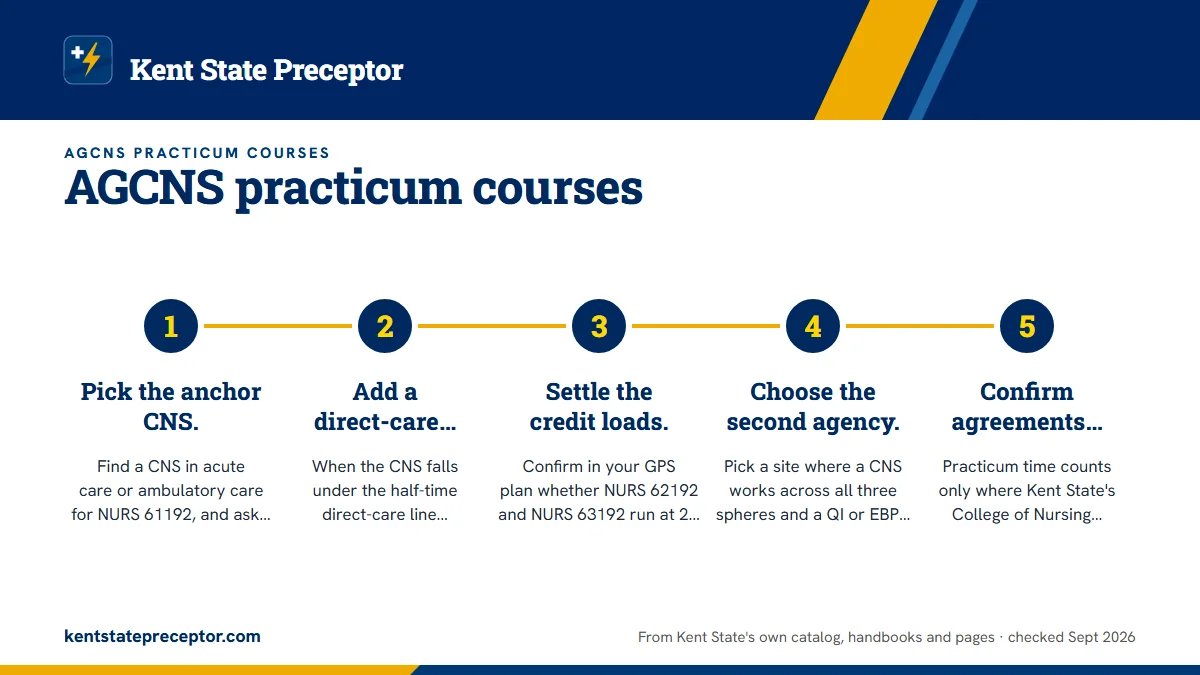
Expect to work in two agencies or more over the three AGCNS practicums; Kent State's rotation page tells students to plan for it. Mapping them before AGCNS I starts saves a scramble later.
- Pick the anchor CNS.Find a CNS in acute care or ambulatory care for
NURS 61192, and ask how much of their week is direct care. - Add a direct-care partner if needed.When the CNS falls under the half-time direct-care line, arrange a CNS, NP or physician in direct care to cover half the hours or more.
- Settle the credit loads.Confirm in your GPS plan whether
NURS 62192andNURS 63192run at 2 or 3 credits, since that sets 150 or 225 hours each. - Choose the second agency.Pick a site where a CNS works across all three spheres and a QI or EBP project is possible.
- Confirm agreements early.Practicum time counts only where Kent State's College of Nursing holds an active affiliation agreement, and new agreements are the college's to set up with each facility.
Where AGCNS practicums happen
The concentration covers adults to older adults from wellness to acute care, and the CNS preceptor can work in acute care or ambulatory settings. Courses are fully online with no campus visits, while each practicum puts you on site near home, licensed as an RN by that state.
The AGCNS has its own state picture: 14 approved states, and a licensure disclosure that puts Michigan and Pennsylvania on the does-not-meet list beside California, New York and American Samoa. Pennsylvania sits on the enrollment list yet fails the licensure check, a conflict to raise with Academic Advising and Student Services. The detail is on licensure disclosures.
AGCNS time and case logs go into Typhon's second database, the one Kent State shares with Nurse Educator and NAHSL students, on the same 15-day deadline as every graduate practicum.
Why AGCNS students choose us
We screen CNS preceptors on the questions Kent State asks: acute care or ambulatory setting, share of time in direct care, and activity across the patient, nurse and system spheres. When a CNS sits under the direct-care threshold, we find the direct-care CNS, NP or physician to pair with them, so the course starts complete. Because the AGCNS is fully online, the search happens where you live, in whichever of Kent State's approved AGCNS states you call home.
We map your two agencies across the three courses from the beginning, prepare each preceptor's license, certification and role details for your practicum faculty and coordinator to review, and raise any affiliation agreement the college will need while there is still time to arrange it. The quickest start is the placement form further down, and how it works explains what happens next.
Questions Kent State students ask
Does my Kent State CNS preceptor have to be an adult-gerontology CNS?
The CNS rotation page looks for a CNS practicing in acute care or ambulatory settings, and its APRN rotation pages ask every preceptor for a minimum of one year in the population-focused area and the role. That points toward a CNS whose practice covers adults and older adults. Bring the person's certification and role history to your practicum faculty, who approve the match.
Can an NP or physician precept Kent State AGCNS hours?
Yes, in one situation Kent State describes. If your CNS gives under roughly half of the workweek to hands-on patient care, a second preceptor joins, a CNS, NP or physician who practices in direct care, and that person covers half the course hours or more. The CNS stays on as your CNS preceptor, and your practicum faculty approve both people before any hours start.
Which certification exams do the AGCNS practicums prepare me for?
Kent State names the ANCC AGCNS-BC and the AACN ACCNS-AG exams, and notes that the curriculum carries AACN verification for the ACCNS-AG exam. Graduates of the AGCNS also meet Ohio's educational standard for APRN licensure, though other states may set extra conditions, and the certification and licensure paperwork is completed by your concentration coordinator.
What happens if my AGCNS practicum is more than three years old?
Kent State's catalog pairs each AGCNS practicum with its lecture for the stale-course rule: NURS 60110 with NURS 61192, NURS 60210 with NURS 62192, and NURS 60310 with NURS 63192. Return from a stop-out with a pair that has aged three years or more, and both courses are taken again. The practicum time limits page covers the rest.
Can I take the AGCNS practicums as part of a DNP?
Kent State offers the AGCNS on an MSN or DNP path, and the BSN-to-DNP route names the AGCNS among its APRN concentrations. BSN-entry students complete the MSN concentration, including all three practicums, and must hold national certification before the DNP courses resume. Details are on the BSN to DNP page.
Related pages
Last checked 2026-09-24
We check these pages against Kent State's own catalog, handbooks and program pages. Your MSN or DNP handbook, your syllabus, your practicum faculty and your concentration coordinator have the final word.
Kent State says the preceptor search is yours. We make it the fastest part of your practicum.
Tell us your Kent State concentration, where you live and which semester your next practicum starts. We find preceptors who fit the course and prepare everything your practicum faculty and coordinator review before they approve.
- Preceptors matched to the course: primary care for
NURS 61292, acute care forNURS 61092, psychiatric care forNURS 61592, women's health forNURS 66192 - Credentials, license and site details ready for your practicum faculty and coordinator
- In your own community, in Ohio or wherever you live and hold your RN license
Start your placement plan
Program, city and semester is all we need to begin.