Kent State practicum hours per credit: what 1, 2 or 3 credits means for your week
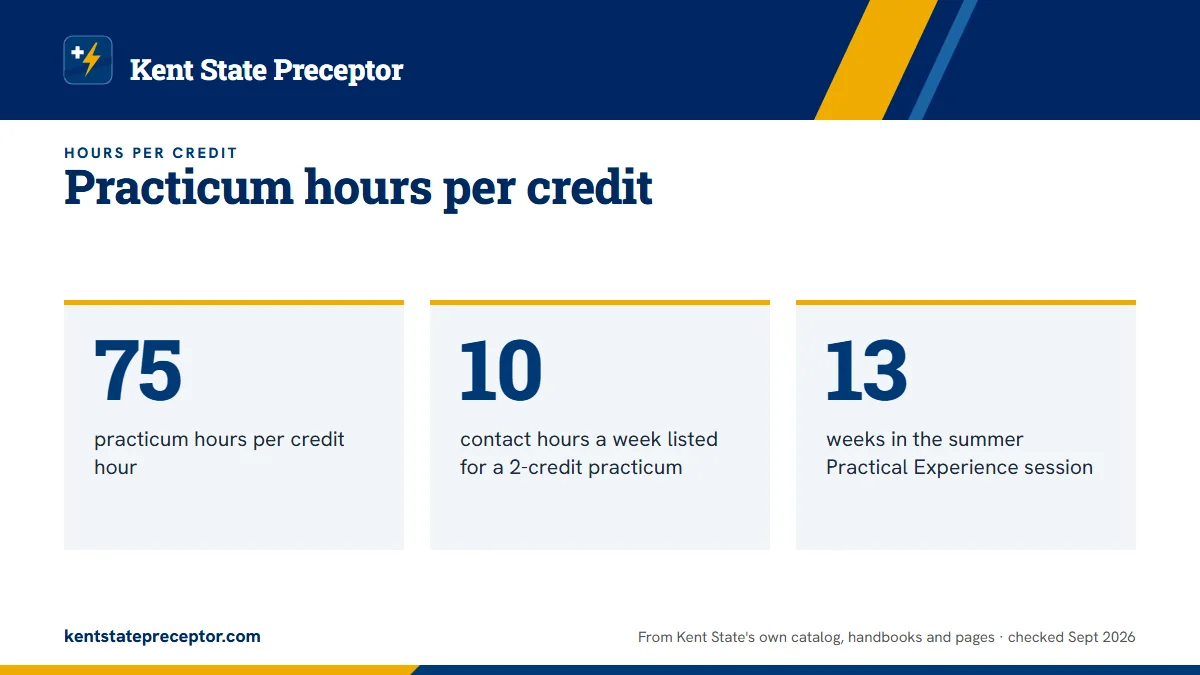
Kent State's catalog sets graduate practicum time at 75 hours for every credit hour: 75 hours for a 1-credit practicum, 150 for 2 credits and 225 for 3. Below, those numbers become weekly schedules, grouped by the Kent State courses that fall at each load, with the handful of courses where the math works differently.
Get your placement plan
Tell us your Kent State program and where you live. A placement advisor replies with the preceptor and site options that fit your Kent State course.
The 75-hour rule and the weekly math
Kent State's 2026-2027 catalog states the rule in its College of Nursing pages: 75 practicum hours per credit hour. Course listings say the same thing another way, as weekly contact hours. A 2-credit graduate practicum lists 10 practicum contact hours a week and a 1-credit practicum lists 5, which over a 15-week semester come to 150 and 75.
| Credits | Practicum hours | Weekly contact hours | Example course |
|---|---|---|---|
| 1 | 75 | 5 (as listed) | NURS 61892 Family and AG NP Role Practicum |
| 2 | 150 | 10 (as listed) | NURS 61292 AG Primary Care I Practicum |
| 3 | 225 | 15 by simple division | NURS 62192 AGCNS II Practicum taken at 3 credits |
Kent State publishes contact hours per week rather than a shift pattern, so the 10-hour figure is an average across the term, not a timetable. How the hours actually fall is something you and your preceptor work out together.
What 10 contact hours a week looks like with a real preceptor
Clinicians rarely work in tidy ten-hour blocks, and Kent State's preceptor guidebook says the preceptor's schedule sets the student's. So 150 hours might mean one long clinic day each week of the term, a 12-hour hospital shift most weeks with an extra shift here and there, or heavier stretches packed into the weeks your preceptor has open.
Some rotations ask for more than the average. The acute care rotation description asks AGACNP students for at least 16 to 20 clinical hours weekly, ideally on back-to-back days when the setting permits. The NAHSL rotation description, by contrast, describes about 10 hours a week on site while the student completes a project for the organization.
The arithmetic also shows why a slow start costs so much. Miss the first five weeks of a 2-credit course and the remaining ten weeks must carry 15 hours each to reach 150 by the last day of the term.
The mistake to avoid: treating the weekly figure as optional. Weeks lost at the start of a term do not vanish; their hours pile onto the weeks that are left.
Kent State practicums at each credit load
Most graduate practicums at Kent State carry 2 credits. Grouping the catalog's courses by load shows where a lighter or heavier term falls in your concentration.
| Load | Hours | Kent State courses |
|---|---|---|
| 1 credit | 75 | NURS 61892 (FNP and AGPCNP role practicum); NURS 63792 and NURS 64792 (Pediatric Primary Care NP, not admitting) |
| 2 credits | 150 | NURS 61292 and NURS 62292 (primary care); NURS 61092, NURS 61392, NURS 62392, NURS 63392 (AGACNP); NURS 61592 to NURS 63592 (PMHNP); NURS 66192, NURS 66392, NURS 66492 (WHNP); NURS 61192 (AGCNS I) |
| 1 or 2 credits | 75 or 150 | NURS 61692 Primary Care Pediatrics Practicum in the FNP certificate (2 credits in the MSN) |
| 2 or 3 credits | 150 or 225 | NURS 62192 and NURS 63192 (AGCNS II and III) |
Some descriptions give only weekly contact hours and no total, including NURS 64592 (PMHNP IV), NURS 66292 (WHNP II), the Nurse Educator practicums and the NAHSL practicums. On paper they follow the same 10-hours-a-week pattern; confirm the hour target in the syllabus for each.
Variable-credit practicums: choosing your hours
A few Kent State practicums let the credit load move, and the hours move with it. The AGCNS II and III practicums, NURS 62192 and NURS 63192, run at 150 hours for 2 credits or 225 hours for 3. That is where the catalog's AGCNS range of 450 to 600 hours comes from, while the program's web page states a flat 525. The AGCNS practicums page covers what each course asks of a CNS preceptor.
In the FNP certificate, NURS 61692 is a variable 1-to-2-credit course worth 75 or 150 pediatric hours, where the MSN FNP fixes it at 2 credits. The FNP hours page shows how that shifts the FNP total.
Your concentration coordinator and your GPS program plan set the load you register for. More credits means more hours with the same preceptor in the same term, so settle the credit figure before you ask anyone to commit, and give the preceptor the exact number of hours.
Where the per-credit math works differently
The 75-hour rule describes the standard practicum course. A few Kent State courses print their own figures, and they are worth knowing before you plan a term around them.
- DNP project courses: the three of them,
NURS 72692,NURS 72792andNURS 72892, are 3 credits apiece yet list 150, 250 and 150 practicum hours. The DNP hours page explains the totals. - The legacy DNP practicum,
NURS 70592, is the reverse case: it follows the rule, stating that 7 credits equal 525 hours. NURS 60592Nursing Education Practicum is a 3-credit course pairing 1 weekly lecture hour with 10 weekly practical contact hours, so not every credit is practicum time.- The SANE certificate practicums, now closed to applicants, are 1 credit and 105 hours each.
- PMHNP students can count faculty supervision time toward the hour total of every practicum, according to the PMHNP rotation description.
Fitting the hours into a 15-week term or the 13-week summer session
Fall and spring give you about 15 weeks. In 2026-2027, fall runs from August 24 through December 13 and spring from January 19 through May 9. Graduate practicum courses carry the Practical Experience schedule type; the 2026 summer version of that session lasted 13 weeks, from May 11 through August 9.
Thirteen weeks changes the division. A 150-hour practicum in the summer session works out to roughly 11.5 hours a week, and a 75-hour course to under 6. Summer is also vacation season for many clinicians, so a summer practicum deserves a firmer schedule agreed before the term opens.
Hours may not begin before the semester's first day without your coordinator's approval, and all of them must be done by the last day. The semester rules page covers early onboarding and the full calendar, and behind on clinical hours covers what to do if you are already short.
Why Kent State students trust us to line up their hours
Credits turn into hours only when a preceptor has room for them. We match you with a preceptor whose schedule can carry your load, whether that is a 75-hour role practicum, a 150-hour primary care course or a 225-hour CNS practicum, in person near where you live.
Ahead of faculty review, we collect what your practicum faculty and concentration coordinator need, from the preceptor's license, credentials and site information to the agency's onboarding steps, and we tell you early whether the agency is already under an affiliation agreement with the College of Nursing. Those reviewers hold the approval; our role is to make their file complete. When a preceptor pulls out mid-term, we start on a replacement right away so your weekly hours keep moving. Begin with the contact form.
Questions Kent State students ask
How many clinical hours is one credit at Kent State?
Kent State's catalog sets 75 practicum hours per credit hour for graduate practicum courses. A 1-credit practicum is 75 hours, 2 credits is 150 and 3 credits is 225. Course listings express the same load as weekly contact hours, 5 a week for 1 credit and 10 a week for 2 credits, across a 15-week semester.
Do I have to complete exactly 10 practicum hours every week?
Not exactly. The 10 contact hours a week in a 2-credit listing is an average, and your preceptor's schedule shapes yours, so some weeks run long and others short. Some rotations do set a weekly floor, such as the AGACNP's 16 to 20 hours, so read your rotation description. The course total must be reached inside semester dates.
How many hours is a 3-credit practicum at Kent State?
By the 75-per-credit rule, 225 hours. The AGCNS II and III practicums, NURS 62192 and NURS 63192, can each be taken at 3 credits and 225 hours. The DNP project courses are the exception: each carries 3 credits, yet their catalog descriptions set 150, 250 and 150 practicum hours.
Does agency onboarding time count toward my practicum hours?
Meeting your preceptor and finishing agency onboarding before the semester are both allowed, but practicum hours cannot start before the first day without coordinator approval. The syllabus for the BSN capstone treats time on agency screening and computer training as outside clinical hours. Ask your practicum faculty how your own syllabus treats onboarding time.
Why does my Kent State practicum list 1-2 credits?
A range means the course is variable credit. In the FNP certificate, NURS 61692 is listed at 1 to 2 credits, which means 75 or 150 hours, and the AGCNS II and III practicums run at 2 or 3 credits. Your concentration coordinator and your GPS program plan decide the load you register for.
Related pages
Last checked 2026-09-24
We check these pages against Kent State's own catalog, handbooks and program pages. Your MSN or DNP handbook, your syllabus, your practicum faculty and your concentration coordinator have the final word.
Kent State says the preceptor search is yours. We make it the fastest part of your practicum.
Tell us your Kent State concentration, where you live and which semester your next practicum starts. We find preceptors who fit the course and prepare everything your practicum faculty and coordinator review before they approve.
- Preceptors matched to the course: primary care for
NURS 61292, acute care forNURS 61092, psychiatric care forNURS 61592, women's health forNURS 66192 - Credentials, license and site details ready for your practicum faculty and coordinator
- In your own community, in Ohio or wherever you live and hold your RN license
Start your placement plan
Program, city and semester is all we need to begin.