Kent State MSN AGCNS: three CNS practicums in a fully online, 40-credit degree
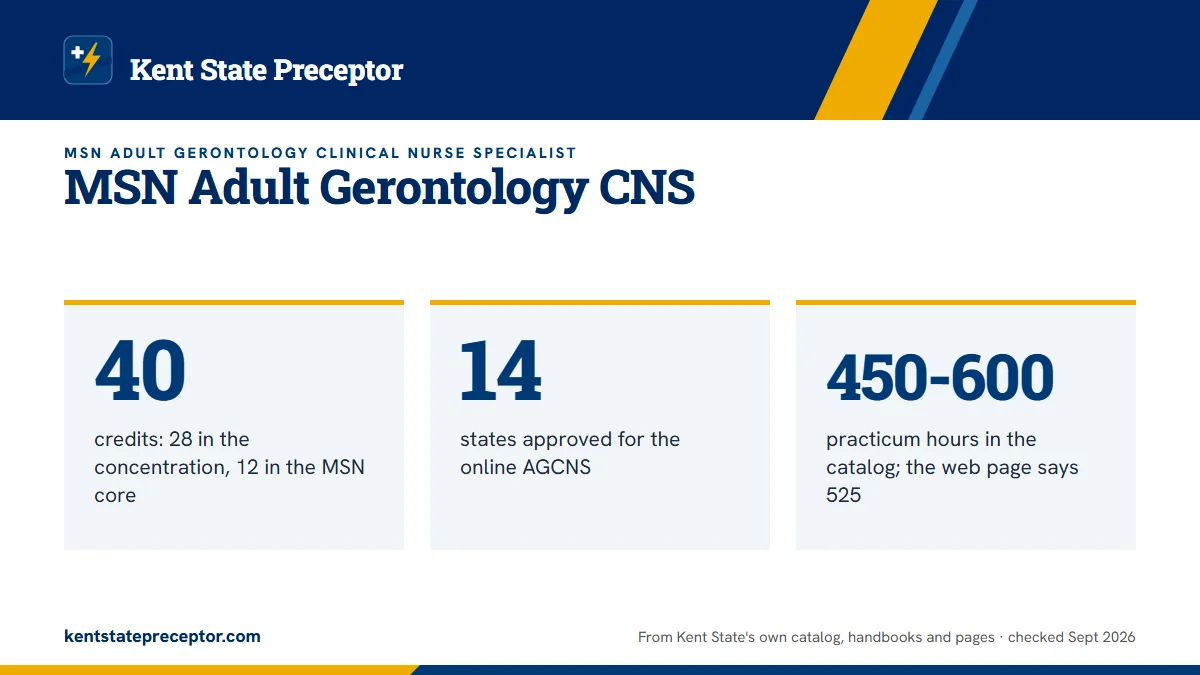
The Adult Gerontology Clinical Nurse Specialist track at Kent State is a 40-credit online MSN that enrolls students from 14 approved states. It has three practicums with CNS preceptors, and Kent State gives two different hour figures for them: 450 to 600 in the catalog, 525 on its web page. Your credit choices for the last two courses decide where you land.
Find CNS preceptors for all three practicums
Tell us your state and which AGCNS course is next. We search for clinical nurse specialists in acute care and ambulatory settings near you.
The AGCNS degree in brief
The AGCNS is a 40-credit degree: at least 28 credits in the CNS concentration and 12 in the MSN core. Kent State's AGCNS page describes it as 100% online, with no orientation or intensive on campus, and lists a fall or spring start. Most AGCNS courses are asynchronous with weekly deadlines, and some hold scheduled live sessions.
The concentration prepares clinical nurse specialists for adults and older adults across the range from wellness to acute care, working in three spheres of impact: the patient, the nurse and the system. That three-sphere model shapes the practicums, which move from direct patient work toward projects that change nursing practice and systems.
You can take the AGCNS as a stand-alone MSN or as the APRN concentration inside Kent State's BSN-entry DNP in Practice Leadership. Either way, look to your GPS plan, not the catalog, for the order of your terms; the Graduate Planning System holds it once you are admitted.
When the first CNS practicum falls
NURS 61192 AGCNS I Practicum opens the clinical sequence, paired with the NURS 60110 lecture, and it requires you to be compliant with the Clinical Compliance Policy. Kent State publishes no AGCNS roadmap, but going by the prerequisite chain, NURS 60015 Advanced Health Assessment has to be finished at least a term before it.
A mandatory first-practicum session is held four to six months out, and during the semester right before NURS 61192 the concentration coordinator helps you find that first site and CNS. Kent State's AGCNS FAQ calls finding a preceptor primarily the student's responsibility, with close support from the coordinator and faculty.
Give the first search that full window, since the preceptor has to be a CNS whose role fits the course. CNS hours go into the second of Kent State's two Typhon databases, the one that also serves Nurse Educator and NAHSL students, with each day's log due within 15 days.
Three practicums, 450 to 600 hours
The first AGCNS practicum is fixed at 2 credits. The second and third can each be taken at 2 or 3 credits, and at Kent State's rate of 75 hours per credit that means 150 or 225 hours apiece. The AGCNS practicum guide covers each course's preceptor and project.
| Practicum | Credits | Hours | Lecture |
|---|---|---|---|
NURS 61192 AGCNS I Practicum | 2 | 150 | NURS 60110 |
NURS 62192 AGCNS II Practicum | 2 or 3 | 150 or 225 | NURS 60210 |
NURS 63192 AGCNS III Practicum | 2 or 3 | 150 or 225 | NURS 60310 |
| Total | 6 to 8 | 450 to 600 |
Kent State's web page for the AGCNS certificate instead gives a single figure, 525 hours, completed with CNS preceptors where you live. By our arithmetic, 525 is what the catalog gives when one later practicum runs at 3 credits and the other at 2, but Kent State does not say so. Ask your concentration coordinator which figure applies to your plan, and see hours per credit for the weekly math.
Kent State gives the AGCNS two hour figures: 450 to 600 in the catalog and 525 on the web page. Settle yours with your coordinator before you book preceptors.
The CNS preceptors you need
The preceptor Kent State describes for the AGCNS is a clinical nurse specialist working in acute care or an ambulatory setting. When that CNS gives under roughly half of their week to direct patient care, a second clinician who does, whether a CNS, an NP or a physician, must cover half or more of the hours, so a CNS in a mostly system-level role means planning a direct-care partner for that course.
The later courses call for a CNS active in the patient, nurse and system spheres alike, and they carry a quality-improvement or evidence-based practice project. Kent State also expects your three practicums to span two agencies or more, so one employer cannot carry the whole concentration.
A CNS preceptor also needs an active, unrestricted license and CNS certification, a year or more in adult-gerontology practice as a CNS, and approval from their employer. Both agencies, and any others, must be under a current College of Nursing affiliation agreement for your hours there to count.
Approved states and a Pennsylvania caution
The 14 AGCNS states, grouped by region, are Ohio with its neighbors Kentucky, Pennsylvania and West Virginia; Connecticut, New Jersey and Maine in the Northeast; Virginia, North Carolina, Florida and Mississippi in the South; Illinois; Montana; and Hawaii. The PMHNP uses the same 14. A move after admission, or a plan to practice somewhere else, should go straight to the Office of Student Services. Approved states compares every program.
The AGCNS has the longest does-not-meet list of Kent State's MSN APRN concentrations: California, Michigan, New York, Pennsylvania and American Samoa. That puts Pennsylvania on both sides, approved for enrollment yet listed as not meeting its educational requirements for licensure. The AGCNS program page, for its part, still says no decision has been reached about APRN licensure outside Ohio. If you live in Pennsylvania, raise it with the Office of Student Services ahead of enrolling; licensure disclosures sets out the sources.
Certification and the DNP path
AGCNS graduates can sit for the ANCC's AGCNS-BC or the AACN's ACCNS-AG certification, and Kent State's curriculum carries AACN verification for the ACCNS-AG. With either credential, the AGCNS also leads to APRN licensure in Ohio, and your concentration coordinator completes the certification and licensure forms as you graduate.
If you enter through the BSN-to-DNP route, the AGCNS is one of the MSN APRN concentrations Kent State names for it, and the master's plus national certification come first, before the rest of the DNP. The BSN to DNP page covers how that route runs. For stop-outs, remember that each AGCNS practicum and its lecture must be repeated once three or more years old, and that graduation calls for a 3.000 overall GPA across the whole degree.
Why AGCNS students choose us
A CNS plan carries rules no NP plan has: the direct-care split, the three-sphere requirement and the two-agency plan. We map all three practicums together, matching each course to a CNS whose role fits it and adding a direct-care partner where the rules call for one.
Every candidate works in person in your approved state. Each is vetted for license, CNS certification and time in role, and the approval details, agency information included, come to you ready for your practicum faculty and coordinator. You hear early when a site needs a new agreement with the college.
Losing a CNS preceptor mid-course starts a fresh search on our side the moment you let us know. Use the form below to send your state and next AGCNS course.
Questions Kent State students ask
Is the Kent State AGCNS a nurse practitioner program?
No. The AGCNS prepares clinical nurse specialists, an APRN role distinct from nurse practitioners, with its own certification exams, the AGCNS-BC and ACCNS-AG. Its hours are logged in a separate Typhon database from the NP concentrations, and its preceptor is a clinical nurse specialist rather than an NP.
Should I take the later AGCNS practicums at 2 or 3 credits?
That choice sets your total hours, so make it with your concentration coordinator. At 3 credits a practicum means 225 hours, or about 15 a week over a 15-week term, against 150 hours and about 10 a week at 2 credits. Also confirm how your choice lines up with the 525 hours on Kent State's web page.
Can I do an AGCNS practicum on my own unit?
Kent State publishes a workplace ban only for the PMHNP, so no rule bars an AGCNS student's employer outright. Because the three practicums must use two or more agencies, though, at least one course happens somewhere else. Your practicum faculty decide whether your own unit can host a course and with which CNS.
Does my AGCNS preceptor have to work in acute care?
No. Kent State's rotation page accepts a clinical nurse specialist in either acute care or ambulatory settings. What matters more is how much of the CNS's time is direct patient care, since a CNS below about half direct care means adding a direct-care CNS, NP or physician for at least half the hours.
Related pages
Last checked 2026-09-24
We check these pages against Kent State's own catalog, handbooks and program pages. Your MSN or DNP handbook, your syllabus, your practicum faculty and your concentration coordinator have the final word.
Kent State says the preceptor search is yours. We make it the fastest part of your practicum.
Tell us your Kent State concentration, where you live and which semester your next practicum starts. We find preceptors who fit the course and prepare everything your practicum faculty and coordinator review before they approve.
- Preceptors matched to the course: primary care for
NURS 61292, acute care forNURS 61092, psychiatric care forNURS 61592, women's health forNURS 66192 - Credentials, license and site details ready for your practicum faculty and coordinator
- In your own community, in Ohio or wherever you live and hold your RN license
Start your placement plan
Program, city and semester is all we need to begin.