Ohio APRN law and who can precept you
In Ohio, nurse practitioners, clinical nurse specialists and nurse-midwives practice under a standard care arrangement with a collaborating physician or podiatrist. That arrangement, the APRN's national certification and Kent State's own preceptor rules together decide who can precept you. Here is how the pieces fit.
Check a preceptor's fit
Tell us your concentration, course and city. Your placement advisor replies with Ohio preceptors whose role and practice fit the course.
Ohio's APRN license in brief
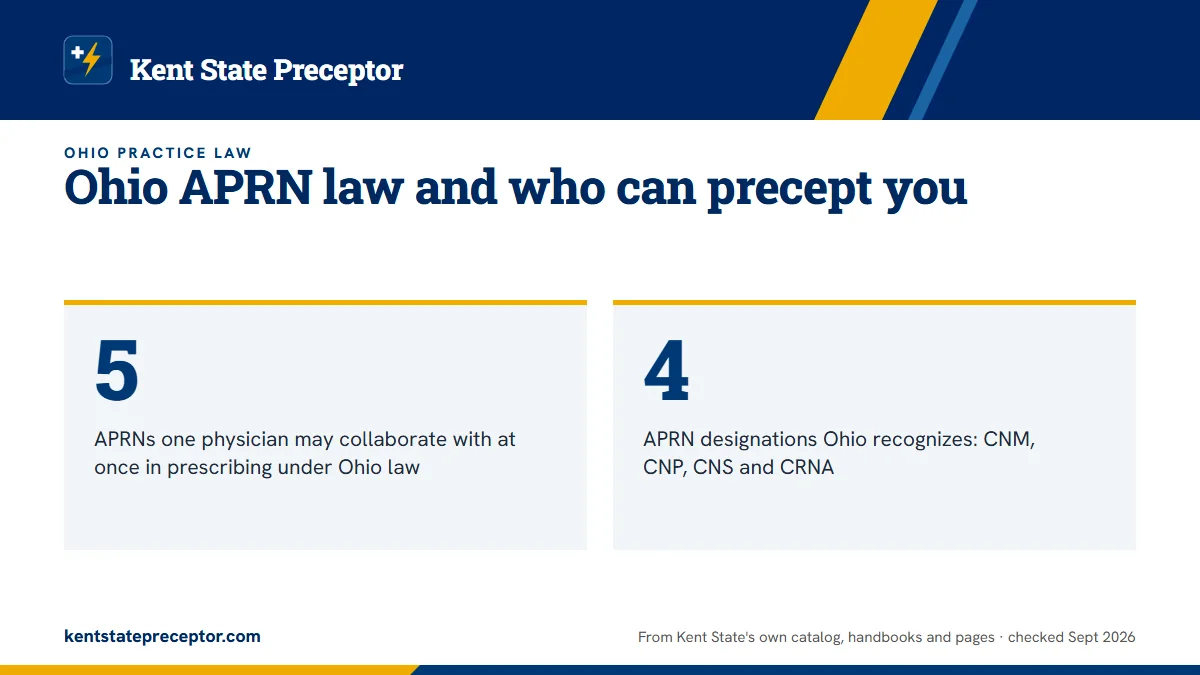
The Ohio Board of Nursing licenses RNs, LPNs and APRNs. Ohio recognizes four APRN designations: certified nurse-midwife (CNM), certified nurse practitioner (CNP), clinical nurse specialist (CNS) and certified registered nurse anesthetist (CRNA). Every Ohio APRN must hold an active RN license, Ohio or multistate, and the APRN license cannot be issued or renewed without one. Ohio APRN applications run through eLicense.Ohio.gov, and APRN licenses renew every two years, in odd-numbered years.
Since HB 216 took effect in April 2017, prescribing for CNPs, CNSs and CNMs has been part of the APRN license itself rather than a separate certificate. Kent State layers its own standard on top: active, unrestricted licensure and certification in the area of practice.
The standard care arrangement, in plain terms
A standard care arrangement (SCA) is a written agreement between an APRN and a collaborating physician or podiatrist. The Board's March 2025 APRN FAQ says a CNP, CNS or CNM needs one to practice, even a CNS who does not prescribe, and the collaborator's specialty has to match the nurse's or come close to it. A CNP or CNS certified in psychiatric care has wider options: a psychiatrist, or a physician in pediatrics, primary care or family practice.
The SCA sets out services and prescribing scope, referral and consultation, chart review, coverage, dispute resolution and quality-assurance terms. The employer keeps it, and the APRN reports the collaborator to the Board within 30 days of starting practice. In prescribing, one physician can collaborate with at most five APRNs at a time, though there is no cap on the number of SCAs, and co-signature is needed only when the SCA or employer requires it.
What the SCA means for your preceptor
Scope follows certification. The Board's FAQ says national certification, not an age cutoff, sets the population an APRN may treat, and an SCA cannot add a population; an FNP certification does not cover unstable or critical patients. That is why Kent State matches preceptor to course: acute care practicums use hospital-based CNPs, MDs or DOs, and FNP pediatrics uses a pediatrician, a PNP or an FNP whose practice centers on children.
Prescribing follows the collaborator. An Ohio APRN's prescribing cannot exceed the collaborating physician's, Schedule I drugs are excluded, and Schedule II prescribing is limited by setting. For PMHNP Practicum II, which calls for a prescriber, look for a PMH APRN or psychiatrist whose own practice includes psychiatric prescribing.
Employer approval matters twice. Kent State wants the employer and practice setting to sign off, and in Ohio the employer also keeps the SCA.
Ohio's student rules and Kent State's preceptor rules
Ohio's Nurse Practice Act includes a student exemption, ORC 4723.32, for anyone enrolled in a program that leads to APRN authorization; such students practice under the program's auspices with supervision. Read the current text on codes.ohio.gov before relying on its wording.
Ohio Administrative Code Chapter 4723-5, which defines a preceptor as an RN or LPN taking no more than two students, governs prelicensure programs only, and nothing we found shows the Board vetting graduate APRN programs or the people who precept in them. For graduate students, Kent State's rules set the standard: one of five roles (APRN, physician, physician assistant, healthcare administrator, Certified Nurse Educator), active and unrestricted licensure and certification, a year or more in practice, and the employer's approval.
Kent State's APRN rotation pages also want twelve months in the same population focus and role before a preceptor takes a student. Our preceptor requirements page covers the concentration rules in full.
Who can precept you in Ohio, role by role
How each role lines up:
| Preceptor | Ohio practice basis | Where Kent State uses them |
|---|---|---|
| CNP | APRN license plus an SCA with a physician or podiatrist | NP concentrations, matched to the CNP's certified population |
| CNS | APRN license plus an SCA, even without prescribing | AGCNS practicums; AGPCNP with faculty approval |
| CNM | APRN license plus an SCA | WHNP practicums |
| Physician (MD or DO) | Can serve as SCA collaborator; the five-APRN limit applies to prescribing | AGACNP, FNP and AGPCNP; a psychiatrist for PMHNP Practicum II; a general OB/GYN for WHNP |
| PA | Not an APRN designation; Kent State's baseline applies | Listed by Kent State; AGPCNP with faculty approval |
| Certified Nurse Educator or healthcare administrator | An SCA applies only if they also practice as an APRN | Nurse Educator and NAHSL practicums |
Whatever the role, Kent State asks for employer approval and at least one year of practice, and an APRN precepting in Ohio must hold Ohio APRN licensure, built on an Ohio or multistate RN license. Students need an Ohio RN license for Ohio practicum; see RN license for practicum.
Recent and pending Ohio law
Two recent rules reach students directly. SB 109, enacted in late 2024, covers informed consent before intimate exams of unconscious patients, and its rules apply to nursing students as well. Board rule OAC 4723-7-08, in effect since February 1, 2024, requires licensees, RN students among them, to report within 30 days any felony, drug offense, OVI or practice-related misdemeanor.
The larger change is still pending. SB 258, the Better Access to Healthcare Act, along with its twin, HB 449, would release CNPs, CNSs and CNMs from the SCA requirement after 2,000 clinical hours; HB 508 sets the bar at 5,000 hours. SB 258 had Senate Health hearings in June 2026 and HB 508 a House hearing in May 2026, with no vote reported as of our last check. Check the Ohio General Assembly for current status.
Why Kent State students choose us for Ohio placements
We read a preceptor's Ohio credentials the way your faculty will: the APRN designation and certified population, an active RN license underneath, a collaborator arrangement that fits the specialty, employer approval and a year in the role. That catches a mismatch, such as an FNP preceptor offered for an acute care course, before it reaches your coordinator. If a practice's employer policy adds a step for students, you hear about it at the start rather than the week before your term.
Then we handle the rest of the placement: a preceptor near you who fits the NURS course, confirmation for your term, the approval details prepared, and an early read on the College of Nursing agreement. Our Ohio NP preceptors page covers the state's health systems, and the form below starts your search.
Questions Kent State students ask
Can a physician precept a Kent State NP student in Ohio?
Yes, where the course allows it. Kent State lists physicians among eligible graduate preceptors, and its rotation pages name them for acute care (MD or DO), family and adult primary care, PMHNP Practicum II (a psychiatrist) and WHNP (a general OB/GYN). PMHNP Practicum IV still calls for a PMH APRN during half or more of its hours.
Does my NP preceptor's collaborating physician have to approve me?
Kent State needs the preceptor's employer and practice site to agree, and in Ohio the employer is also the party that keeps the SCA. Ask the practice early whether its own policies add a step for students, such as a word with the collaborating physician.
Is Ohio a full practice authority state for nurse practitioners?
Not as of mid-2026. Ohio CNPs, CNSs and CNMs practice under a standard care arrangement with a collaborating physician or podiatrist. Bills that would let experienced APRNs practice without one, SB 258 and HB 449 at 2,000 clinical hours and HB 508 at 5,000, were pending as of June 2026.
Does Ohio cap how many students a graduate preceptor can take?
The Board's two-student preceptor limit sits in the prelicensure rules, OAC Chapter 4723-5, which do not govern APRN programs. Kent State's rotation pages suggest one preceptor to two students if the preceptor carries no patient load of their own, and one to one if they do.
Can a clinical nurse specialist precept an NP student?
In some courses. Kent State's AGPCNP rotation page allows a CNS or PA to precept with faculty approval, and AGCNS students work mainly with CNS preceptors. For other NP concentrations, the course's rotation description names the preceptor roles; follow it and confirm with practicum faculty.
Related pages
Last checked 2026-09-24
We check these pages against Kent State's own catalog, handbooks and program pages. Your MSN or DNP handbook, your syllabus, your practicum faculty and your concentration coordinator have the final word.
Kent State says the preceptor search is yours. We make it the fastest part of your practicum.
Tell us your Kent State concentration, where you live and which semester your next practicum starts. We find preceptors who fit the course and prepare everything your practicum faculty and coordinator review before they approve.
- Preceptors matched to the course: primary care for
NURS 61292, acute care forNURS 61092, psychiatric care forNURS 61592, women's health forNURS 66192 - Credentials, license and site details ready for your practicum faculty and coordinator
- In your own community, in Ohio or wherever you live and hold your RN license
Start your placement plan
Program, city and semester is all we need to begin.