Kent State PMHNP practicums: therapy, prescribing, groups and the NP role
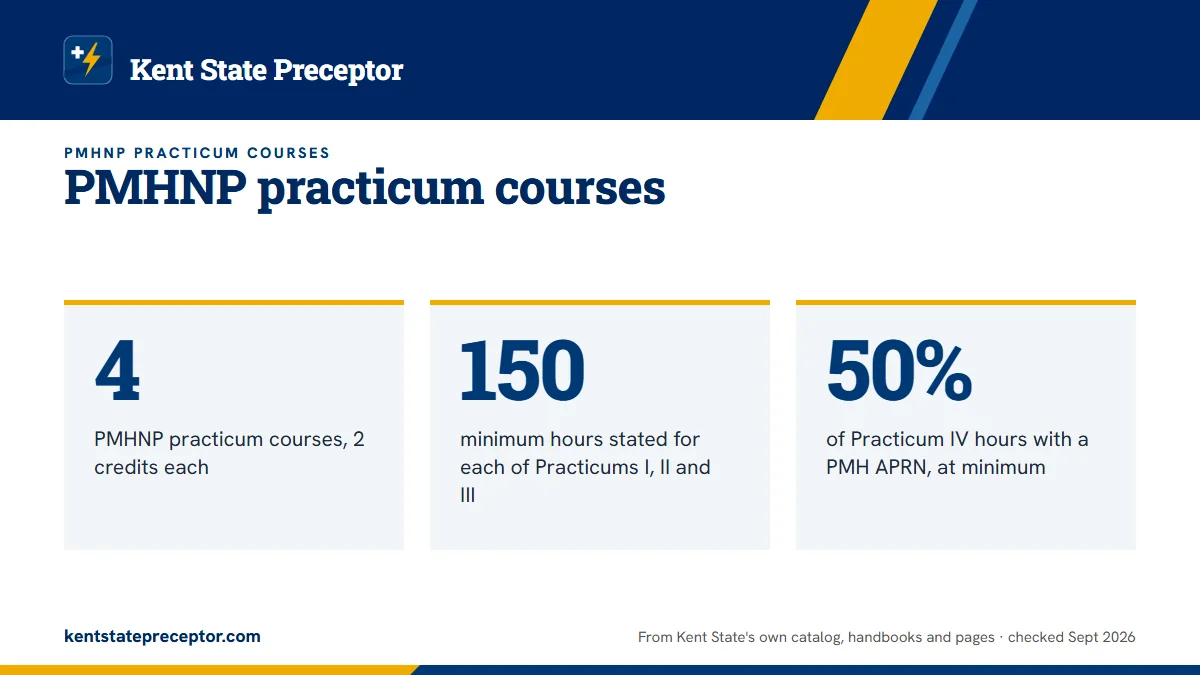
The Psychiatric Mental Health NP concentration has four 2-credit practicums, and each asks for a different kind of preceptor. Practicum I needs a mental health clinician with psychotherapy experience, Practicum II a prescriber, and Practicum IV a PMH APRN for no less than half the hours, all at a site that is not your own workplace.
Match each PMHNP course to the right clinician
Tell us your state and which practicum comes next. We search for the preceptor type Kent State asks for.
The four PMHNP practicums at a glance
Every PMHNP practicum is a 2-credit course with 10 weekly contact hours, and Kent State builds group supervision into all four. The catalog sets a 150-hour minimum for Practicums I, II and III but prints no hour figure for Practicum IV. Pair those three minimums with a 150-hour estimate for the fourth, derived from its weekly contact hours, and you reach the 600 shown in our clinical hours guide.
Two rules run through every course. Across the four practicums your patients must span the lifespan, and Kent State counts faculty supervision time toward each course's hour total, per the PMHNP rotation page.
| Course | Credits | Hours | Paired course | Preceptor Kent State asks for |
|---|---|---|---|---|
NURS 61592 Practicum I: Individual Therapy | 2 | 150 minimum | NURS 60151, co-requisite | Licensed mental health provider experienced in psychotherapy |
NURS 62592 Practicum II: Medication Management and Individual Therapy | 2 | 150 minimum | NURS 60441, pre- or co-requisite | A prescriber: PMH APRN or psychiatrist |
NURS 63592 Practicum III: Family and Group Therapy | 2 | 150 minimum | NURS 60251, co-requisite | Confirm with your practicum faculty |
NURS 64592 Practicum IV: Nurse Practitioner Role | 2 | Not stated (about 150 by contact hours) | NURS 60353, co-requisite | PMH APRN for at least half the hours |
NURS 61592 Practicum I: individual therapy
Practicum I stays closed until you have passed NURS 60012 and NURS 60051, each worth 4 credits, which pushes the earliest first practicum into your second PMHNP term. It runs with NURS 60151, needs special approval to register, and requires full clinical compliance first.
Your preceptor here is a licensed mental health clinician with psychotherapy experience. A PMH APRN is the ideal but not a requirement, so a licensed therapist who does real psychotherapy work can qualify once your practicum faculty approve. Kent State rejects medication-only placements and staff-nurse placements for this course, which is built around individual therapy.
Coordinator help with the first placement and the required orientation, held four to six months ahead, both attach to this course, so your search runs during the opening PMHNP term. The finding your own preceptor guide describes how the coordinator's role fits beside yours.
NURS 62592 Practicum II: medication management with therapy
Practicum II brings prescribing in. The preceptor must be a prescriber, meaning a PMH APRN or a psychiatrist, and NURS 60441 Pharmacology for the APRN comes before or with the course. Individual therapy stays in the title, so ask your practicum faculty how the syllabus divides your time between medication visits and therapy before you choose a practice. Check too that the prescriber's license carries no restrictions and that they have spent a year or more in the psychiatric population and role.
NURS 62592 is also the only PMHNP practicum the catalog's stale-course rule names without a lecture partner. Should it pass the three-year mark while you are stopped out, you retake it alone; the other three are retaken together with their lectures. Practicum time limits covers the rule.
NURS 63592 Practicum III: family and group therapy
Practicum III runs with NURS 60251 and moves from single patients to families and groups. Kent State's published preceptor rules name specific types for Practicums I, II and IV. For Practicum III, get the preceptor type from your syllabus or practicum faculty before you commit to a site, and keep the lifespan rule in view. If one site cannot offer both family and group work, ask whether a second site is acceptable; any added site needs its own affiliation agreement on file with the college.
The PMHNP program page points to a wide spread of workplaces, from private practice and community mental health to correctional facilities, emergency departments, primary care and consultation-liaison teams inside hospitals. When you screen a site for this course, ask how much of the preceptor's week goes to family or group sessions, since that is the course focus.
NURS 64592 Practicum IV: the NP role immersion
The final course, paired with NURS 60353, is a full immersion in the nurse practitioner role. Kent State wants a PMH APRN supervising no less than half of its hours, so if two preceptors share the course, the PMH APRN's share has to be the larger one or an even split.
The catalog gives NURS 64592 ten weekly contact hours and no hour total. Our 150-hour figure is an estimate from those contact hours over a 15-week term; your syllabus carries the real requirement. Clinical time also has to wrap up by the semester's final day, so plan this schedule backward from that date.
When Practicum IV is split between two preceptors, the PMH APRN covers half the hours or more. Secure that person first, then fill the rest.
Your workplace, your state and your logs
The PMHNP is the one Kent State concentration with a published workplace ban: your practicum site cannot be the place that employs you. A mental health RN who works at a community agency therefore looks elsewhere for every rotation. The practicum at your workplace page sets this beside the rules for other concentrations.
Coursework is fully online; clinical work is in person, close to home, in the state that issued your RN license. Kent State approves 14 states for the online PMHNP, listed on approved states. Each clinical day goes into the NP side of Typhon within 15 days, as the Typhon guide explains. Planning a move mid-program? Let the college's Office of Student Services know promptly, since some state laws can block practicum courses.
How we build a PMHNP placement plan
We match each PMHNP course to the clinician Kent State asks for: a licensed psychotherapy provider for Practicum I, for Practicum II, a psychiatrist or PMH APRN who writes prescriptions, then a preceptor approved by your faculty for the family and group course, and a PMH APRN able to carry half or more of Practicum IV.
Every candidate we bring you works outside your own employer, and we check that the four placements together cover the lifespan. License, certification and years in role are laid out for your practicum faculty and concentration coordinator, and if a practice needs a new College of Nursing agreement, you hear about it from us in time for the college to act.
Use the request form lower on this page to begin. Our process is set out on how it works.
Questions Kent State students ask
Can a licensed counselor or psychologist precept Kent State PMHNP Practicum I?
Kent State's Practicum I rule calls for a licensed mental health clinician with psychotherapy experience, naming a PMH APRN as ideal but not required. License types are not listed one by one, so take the candidate's license and therapy background to your practicum faculty for approval. Prescribers who only manage medication, and staff nurses, are the placements Kent State names as unacceptable.
Do faculty supervision hours count toward PMHNP practicum hours?
Yes. Kent State's PMHNP rotation page counts faculty supervision time toward each course's hours, and the catalog notes that group supervision comes with all four practicums. How many supervision hours a course includes is set in its syllabus, so check it before you agree on a weekly schedule with your preceptor.
Can I do PMHNP practicum in a different unit of the hospital where I work?
The published rule bars your own workplace as a practicum site and carves out no exception for other units or departments. Before you assume a different unit or campus counts as a separate site, put the question to your practicum faculty in writing and keep their answer with your placement records.
When should I start looking for a PMHNP Practicum I preceptor?
Start during your first PMHNP term, while you are taking NURS 60012 and NURS 60051. The required orientation comes four to six months before the course, and your concentration coordinator helps in the term before it, so the search and your first courses overlap. Starting then also leaves room for the college to set up an affiliation agreement if your chosen site needs one.
Which certification exam do the PMHNP practicums lead to?
The exam Kent State points PMHNP graduates toward is ANCC's PMHNP certification. The four practicums give you the supervised therapy, prescribing, family and group, and role hours that the concentration builds toward. The certification and licensure forms go through your concentration coordinator, and Kent State's MSN NP licensure disclosure marks California, New York and American Samoa as jurisdictions where the program falls short.
Related pages
Last checked 2026-09-24
We check these pages against Kent State's own catalog, handbooks and program pages. Your MSN or DNP handbook, your syllabus, your practicum faculty and your concentration coordinator have the final word.
Kent State says the preceptor search is yours. We make it the fastest part of your practicum.
Tell us your Kent State concentration, where you live and which semester your next practicum starts. We find preceptors who fit the course and prepare everything your practicum faculty and coordinator review before they approve.
- Preceptors matched to the course: primary care for
NURS 61292, acute care forNURS 61092, psychiatric care forNURS 61592, women's health forNURS 66192 - Credentials, license and site details ready for your practicum faculty and coordinator
- In your own community, in Ohio or wherever you live and hold your RN license
Start your placement plan
Program, city and semester is all we need to begin.