Precepting a Kent State graduate nursing student
Kent State graduate nursing students complete their practicums in person with clinicians in their own communities, and Kent State makes finding those clinicians primarily the student's job. If you are an APRN, physician, PA, certified nurse educator or health care administrator, here is what teaching one involves: who qualifies, how much time a course takes, what the college handles and what it offers its preceptors in return.
Offer to precept
Tell us your role, specialty, city and the terms that suit you. Your placement advisor replies with Kent State students whose course fits your practice.
Who can precept a Kent State graduate student
Kent State's Become a Preceptor page sets the baseline. Five roles qualify: advanced practice registered nurse, physician, physician assistant, Certified Nurse Educator and health care administrator. You also need an active, unrestricted license and certification in your field, a minimum of one year in clinical practice, and your employer's approval of the arrangement. On APRN rotations, Kent State's accreditation standards add twelve months in the population focus and role you would teach.
Each concentration then narrows the fit, as the table shows. The preceptor requirements page carries the full rules.
| Concentration | Preceptors Kent State describes |
|---|---|
| FNP and AGPCNP | An FNP, AGNP or physician in family practice, internal medicine or adult primary care; FNP pediatric hours with a PNP, pediatrician or pediatrics-focused FNP |
| AGACNP | A CNP, MD or DO in hospital settings, critical care included |
| PMHNP | A psychotherapy-experienced mental health provider, then a prescriber, then a PMH APRN |
| WHNP | A CNM, WHNP, FNP or OB/GYN in settings with good gynecologic or obstetric volume |
| AGCNS | A CNS in acute care or ambulatory settings |
| Nurse Educator | An experienced nurse educator in an academic or staff-development setting |
| NAHSL and MSN/MBA | A master's-prepared leader, MSN preferred |
The time a practicum takes
Kent State sets 75 practicum hours per credit. Most two-credit practicums therefore run 150 hours, about 10 a week across a 15-week semester, and one-credit role practicums such as NURS 61892 run 75. Acute care asks more: students on AGACNP rotations are expected on site 16 to 20 hours or more each week, ideally on back-to-back days. NAHSL students spend roughly 10 hours weekly at the organization and deliver a project for it.
Your schedule sets the student's, not the reverse. Hours fall inside Kent State's semester dates, which for 2026-27 means fall classes from August 24 to December 13, spring from January 19 to May 9, and a 13-week Practical Experience session in summer. A student may meet you and complete your agency's onboarding before the term begins, so the first week of the semester can be productive for both of you.
What the college handles for you
Kent State keeps a preceptor's paperwork short. New preceptors begin with a Qualtrics interest form, after which the college guides them through employer approval, and your current CV goes to the student's graduate faculty member. The student's hours count only if your facility has an affiliation agreement in force with the College of Nursing, and the college works out that contract with the facility directly.
Each semester opens with an email from the student's assigned faculty member carrying contacts, links, the syllabus and Kent State's Typhon guide for preceptors, and that faculty member stays your liaison through the term. Kent State also carries liability coverage for its students during graduate practicum courses. For Ohio clinicians, the Board of Nursing's preceptor rules sit in its prelicensure chapter and do not govern graduate APRN programs, so Kent State's criteria are the ones to meet; the Ohio APRN rules page explains the state side.
Typhon and your evaluation of the student
Kent State tracks practicum hours in Typhon. The student logs time and cases within 15 days of each day with you, and you can view the schedule and those entries as they come in. At the end of the course you submit the final evaluation in Typhon, and faculty review it alongside the student's logs. Your evaluation becomes part of the student's record, while the course grade stays with faculty. Kent State's guidebook calls it an NP evaluation even where the same page addresses CNS, educator and leadership preceptors, so ask the student's faculty member if an item seems not to fit your role.
Students evaluate you and the site as well. At semester end, faculty complete an hour-verification form documenting the hours you taught, which is useful for your own portfolio. The preceptor evaluations page covers both directions of feedback.
What Kent State offers its preceptors
Kent State recognizes the clinicians who teach its students in several ways. The College of Nursing, an Ohio Nurses Association-approved provider, offers continuing education through PreceptED, a CE library built for its preceptors. For Ohio APRNs, who need 24 hours of continuing education per APRN license at each renewal after the first, a CE library from an approved provider is a practical draw. More than 350 Kent State preceptors have received its Barbara Donaho Distinguished Leadership in Learning Award.
The college also lists relief on a graduate application fee, described on one page as a DNP fee reimbursement and on another as a graduate nursing fee waiver, along with unpaid adjunct faculty status tied to the Kent Campus and research collaboration. Its graduate preceptor pages link to the AANP Preceptor Toolkit and the NONPF Preceptor Portal. Our preceptor benefits page sets out each item in more detail.
How to connect with a Kent State student through us
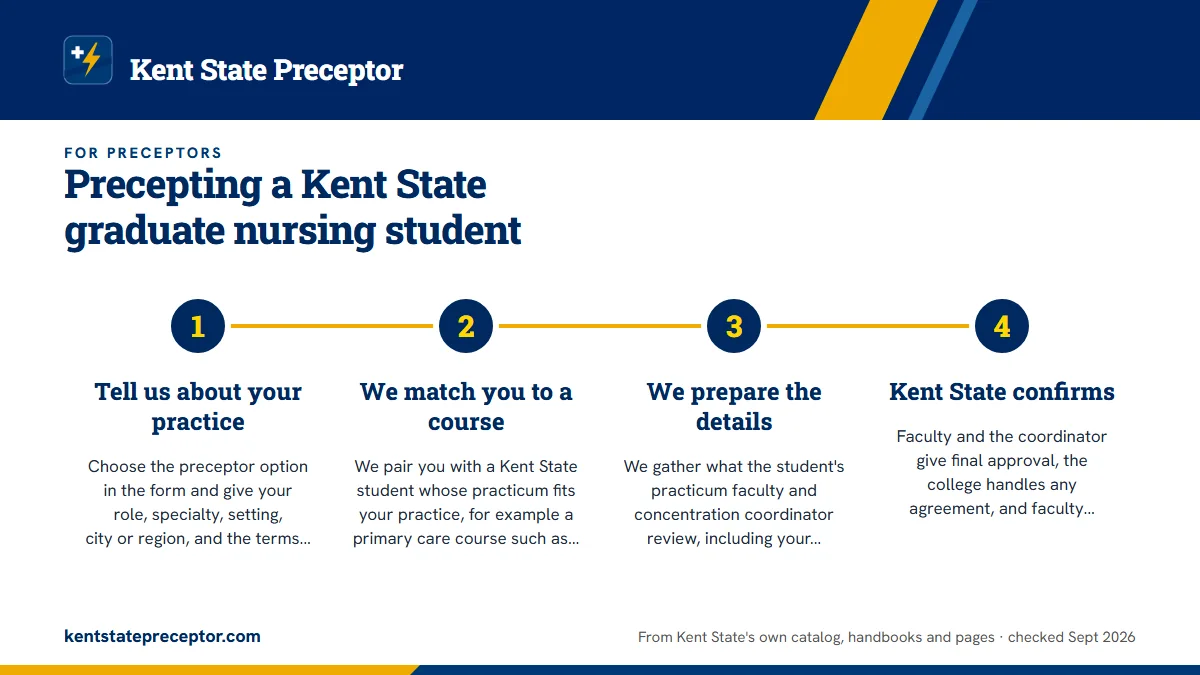
- Tell us about your practiceChoose the preceptor option in the form and give your role, specialty, setting, city or region, and the terms and weekly hours that suit you.
- We match you to a courseWe pair you with a Kent State student whose practicum fits your practice, for example a primary care course such as
NURS 61292or a psychiatric course such asNURS 62592. - We prepare the detailsWe gather what the student's practicum faculty and concentration coordinator review, including your credentials and site details, and find out early whether your facility is already under agreement with the College of Nursing.
- Kent State confirmsFaculty and the coordinator give final approval, the college handles any agreement, and faculty contact you when the term begins.
Where a health system handles student requests centrally, let us know and we go through that office. This route is for graduate students; Kent State and its hospital partners assign BSN capstone preceptors themselves.
Questions Kent State students ask
Can I precept more than one Kent State student at a time?
Kent State recommends one preceptor to two students when you are not seeing your own patients, and one to one when you are. Within that guidance, your employer's approval and your caseload decide. Tell us your capacity when you write, and we match students to it.
Do I need an Ohio license to precept a Kent State student?
You need an active, unrestricted license and certification where you practice. Kent State's online students do practicums in their home state, so a preceptor in Pennsylvania or West Virginia practices under that state's credentials. In Ohio, an APRN preceptor holds an Ohio APRN license, which itself depends on an active Ohio or multistate RN license.
Can my facility host a Kent State student?
Hosting depends on two things: an affiliation agreement between your facility and the College of Nursing, which the college sets up, and your employer's approval. Note that Kent State bars PMHNP students from training at their own workplace, so a PMHNP student who is also your coworker needs a different site.
Can a new APRN precept a Kent State student?
Kent State wants a year or more of clinical practice, plus, on APRN rotations, twelve months in that population focus and role, a rule it ties to accreditation. A clinician in the first year of APRN practice would wait until reaching that mark before taking a student.
Who do I contact at Kent State once I am precepting?
Your contact is the student's assigned practicum faculty member, who emails you at the start of the semester with the syllabus, links and the Typhon guide. For questions about the course, the student's progress or the evaluation, go to that faculty member first.
Related pages
Last checked 2026-09-24
We check these pages against Kent State's own catalog, handbooks and program pages. Your MSN or DNP handbook, your syllabus, your practicum faculty and your concentration coordinator have the final word.
Kent State says the preceptor search is yours. We make it the fastest part of your practicum.
Tell us your Kent State concentration, where you live and which semester your next practicum starts. We find preceptors who fit the course and prepare everything your practicum faculty and coordinator review before they approve.
- Preceptors matched to the course: primary care for
NURS 61292, acute care forNURS 61092, psychiatric care forNURS 61592, women's health forNURS 66192 - Credentials, license and site details ready for your practicum faculty and coordinator
- In your own community, in Ohio or wherever you live and hold your RN license
Start your placement plan
Program, city and semester is all we need to begin.