Doing your Kent State practicum where you work
Kent State publishes one outright rule here: PMHNP students may not use their own workplace as a practicum site. Leadership (NAHSL) students are nudged to search past their own unit and employer, and the other concentrations publish no workplace rule at all, which leaves the decision with your practicum faculty and concentration coordinator. Where it is allowed, your employer still needs an affiliation agreement, and every course rule still applies.
Need a site outside your employer?
Tell us your concentration, your next practicum course and where you work. Your placement advisor replies with outside preceptor and site options.
What Kent State publishes, by concentration
Workplace rules appear only on Kent State's Clinical Rotation Description pages, and most of those say nothing directly. The table pairs each concentration with its published rule, or with the course rule that caps how much of a practicum one familiar setting can cover.
| Concentration | Published workplace rule | Rule that limits one familiar site |
|---|---|---|
| PMHNP | Site may not be your own workplace | Practicum I needs a psychotherapy-experienced provider, II a prescriber, IV a PMH APRN for at least half the hours |
| NAHSL and MSN/MBA | Look outside your own unit or employer | Preceptor ideally one or two levels above your current role |
| AGACNP | None published | Final practicum spans 2-3 unfamiliar specialties, at least 50 hours each |
| AGPCNP | None published | No more than 40 hours in any one specialty |
| FNP | None published | Final lifespan practicum may need a second site to reach every age group |
| AGCNS | None published | Plan on at least two agencies across the three practica |
| WHNP and Nurse Educator | None published | The setting must match the course: GYN or OB volume, or an academic or staff-development setting |
No Kent State page addresses relatives or direct supervisors as preceptors. Read that silence as a question for your practicum faculty, not as permission.
PMHNP: the one outright ban
The psychiatric mental health rotation page is explicit: the practicum site may not be the student's own workplace. It is the only exclusion of its kind anywhere in Kent State's public preceptor material, and it shapes all four PMHNP practicums, NURS 61592 through NURS 64592.
The ban reshapes the whole search. Each course needs a particular kind of preceptor: someone licensed in mental health with psychotherapy experience for Practicum I, a prescribing PMH APRN or psychiatrist for Practicum II, and a PMH APRN for half or more of Practicum IV, with lifespan experience across the set. A PMHNP student who works on a behavioral health unit has to find every one of those somewhere else.
If your employer is a large system with many locations, how far the ban reaches is a question for your coordinator before you approach a sister site. Our PMHNP practicums page covers each course's preceptor type.
NAHSL and the MSN/MBA: look beyond your unit
The leadership concentration stops short of a ban but points the same way. Kent State's NAHSL rotation page urges students to go past their own unit or employer, and it wants a preceptor who is a master's-prepared leader, preferably with an MSN, sitting one or two rungs above the role you hold now.
The reason is the work itself. You complete a project for the site, averaging about 10 hours a week on site, across NURS 64292 and NURS 64392, and Kent State's program page says the two practica let students try different leadership paths. Staying inside your own department narrows both the project and the paths.
A different division of your own employer can still be worth raising with faculty, because the page encourages an outside site rather than requiring one. The MSN/MBA takes the same practicum courses, so the same guidance applies to dual-degree students.
Other concentrations: allowed in principle, capped in practice
For AGACNP, AGPCNP, FNP, WHNP, AGCNS and Nurse Educator students, Kent State publishes no workplace rule. Faculty and your coordinator decide case by case at approval. The course rules, though, keep any single familiar setting from carrying a whole program.
An acute care nurse who works in an ICU has to meet the final AGACNP practicum's demand for 2 to 3 unfamiliar specialties, at least 50 hours each, somewhere other than that ICU. An AGPCNP student can log no more than 40 hours in any one specialty. FNP students need pediatric hours with a pediatric NP, a pediatrician or an FNP who mainly sees children, and the final lifespan practicum may need a second site. AGCNS students are told to expect two or more agencies over their three practica.
So a workplace can often host one practicum, or part of one, and the rest of the sequence needs sites that fill the gaps. Our preceptor requirements page lists every concentration's rules in one place.
How to make a workplace site count
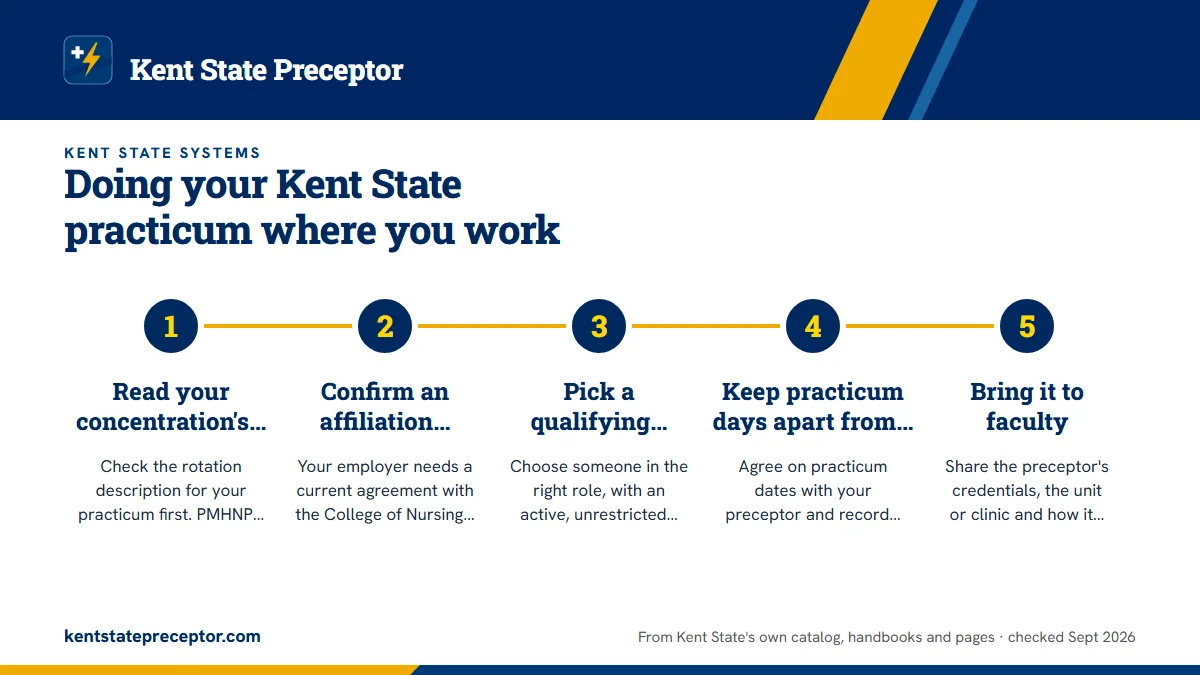
- Read your concentration's ruleCheck the rotation description for your practicum first. PMHNP students stop here and plan an outside site.
- Confirm an affiliation agreementYour employer needs a current agreement with the College of Nursing like any other site, or hours there will not count. The college sets it up with the facility, so ask early.
- Pick a qualifying preceptorChoose someone in the right role, with an active, unrestricted license, a year or more of experience in your population focus and role, and their employer's permission to precept.
- Keep practicum days apart from shiftsAgree on practicum dates with your preceptor and record them in Typhon. Keep them separate from paid shifts so your logs show practicum days only.
- Bring it to facultyShare the preceptor's credentials, the unit or clinic and how it meets the course objectives. Final approval sits with practicum faculty and your coordinator.
- Wear the student badgeOn practicum days you wear the College of Nursing badge, which shows your name, concentration and the College, with no degrees or other affiliations.
Our affiliation agreements page explains how to plan around the agreement step, which has no published lead time.
Where workplace practicums go wrong
The most common problem is assuming the agreement is automatic because you already work there. Being employed by a facility and the facility holding a College of Nursing affiliation agreement are separate matters, and practicum hours count only with the agreement.
The second is choosing a preceptor who is also your manager. Kent State has no published rule on supervisors, but your preceptor submits your final evaluation, and the NAHSL guidance on precepting from one or two levels above shows Kent State does think about role distance. Raise any reporting relationship with faculty before you ask.
The third is staying in a comfort zone. A familiar unit feels efficient, but specialty caps and unfamiliar-specialty rules exist to widen what you see across a program. If your workplace covers only part of a practicum, the remainder still needs its own preceptor and site, with the same approval.
Working at a facility does not place it under a College of Nursing affiliation agreement. Confirm the agreement before you log a single practicum hour there.
Why Kent State students choose us for the sites work can't cover
Most workplace plans leave gaps: the unfamiliar specialties, the pediatric block, the second agency, or for PMHNP students, every site. That is where we come in. We locate preceptors near home whose practice suits the exact course, outside your employer when the rules call for it, and we check each one against your concentration's rotation page before you see it.
We bundle the preceptor's credentials and license with a short site profile and whatever the agency requires for onboarding, and hand it to your faculty and coordinator for their decision. We tell you early if a site still lacks an agreement with the College of Nursing, which gives the college time to put one in place. If a preceptor drops, we find the replacement. Describe your workplace and next course in the request form here, or see how it works.
Questions Kent State students ask
Can my nurse manager be my Kent State preceptor?
Kent State publishes no rule on supervisors or relatives as preceptors; its only published exclusion is the PMHNP workplace ban. Your preceptor still has to meet the role, license, experience and employer-approval criteria, and final approval rests with practicum faculty and your concentration coordinator. Raise the reporting relationship with faculty before you make the request.
Does my hospital need an affiliation agreement if I already work there?
Yes. Under the MSN Student Handbook, a facility's practicum hours count only while it holds a current agreement with the College of Nursing, employer or not. The college, not the student, arranges agreements with facilities, and Kent State publishes no lead time for a new one, so ask your practicum faculty early whether your employer already has an agreement in place.
Can a PMHNP student train at a different location of the same health system?
Kent State's PMHNP rotation page says the site may not be the student's own workplace, but it does not define how far that reaches in a multi-site system. Ask your concentration coordinator before approaching a sister location. Either way, across the practicums you need a psychotherapy-experienced provider, a prescriber and a PMH APRN.
Can an AGACNP student do the final practicum in their own ICU?
Not for the unfamiliar-specialty portion. Kent State's AGACNP rotation page says the final practicum covers 2 to 3 specialties that are new to you, at least 50 hours each, and your home ICU is already familiar. The earlier acute care practicums carry no published workplace rule, so ask faculty whether your unit could fit one of those.
Do NAHSL students have to leave their employer entirely?
No. The rotation page recommends an outside unit or employer; it stops short of a rule. The fixed points are a preceptor with a master's degree who leads at least a level or two above you, and a site project averaging about 10 on-site hours a week. A different division can work if faculty agree.
Related pages
Last checked 2026-09-24
We check these pages against Kent State's own catalog, handbooks and program pages. Your MSN or DNP handbook, your syllabus, your practicum faculty and your concentration coordinator have the final word.
Kent State says the preceptor search is yours. We make it the fastest part of your practicum.
Tell us your Kent State concentration, where you live and which semester your next practicum starts. We find preceptors who fit the course and prepare everything your practicum faculty and coordinator review before they approve.
- Preceptors matched to the course: primary care for
NURS 61292, acute care forNURS 61092, psychiatric care forNURS 61592, women's health forNURS 66192 - Credentials, license and site details ready for your practicum faculty and coordinator
- In your own community, in Ohio or wherever you live and hold your RN license
Start your placement plan
Program, city and semester is all we need to begin.