Kent State nursing practicum in Ohio
Ohio is Kent State's home state, and for most of its nursing students it is also where practicum happens: every BSN clinical, the campus-linked NP tracks and the online programs of Ohio residents. Ohio is on every Kent State online nursing list, each Ohio licensure row reads MEETS, and the named clinical partners cluster in Northeast Ohio. Ohio law sets the terms, with nurse practitioners working under a standard care arrangement.
Get your placement plan
Tell us your Kent State program and where you live. A placement advisor replies with the preceptor and site options that fit your Kent State course.
What Kent State lists for Ohio
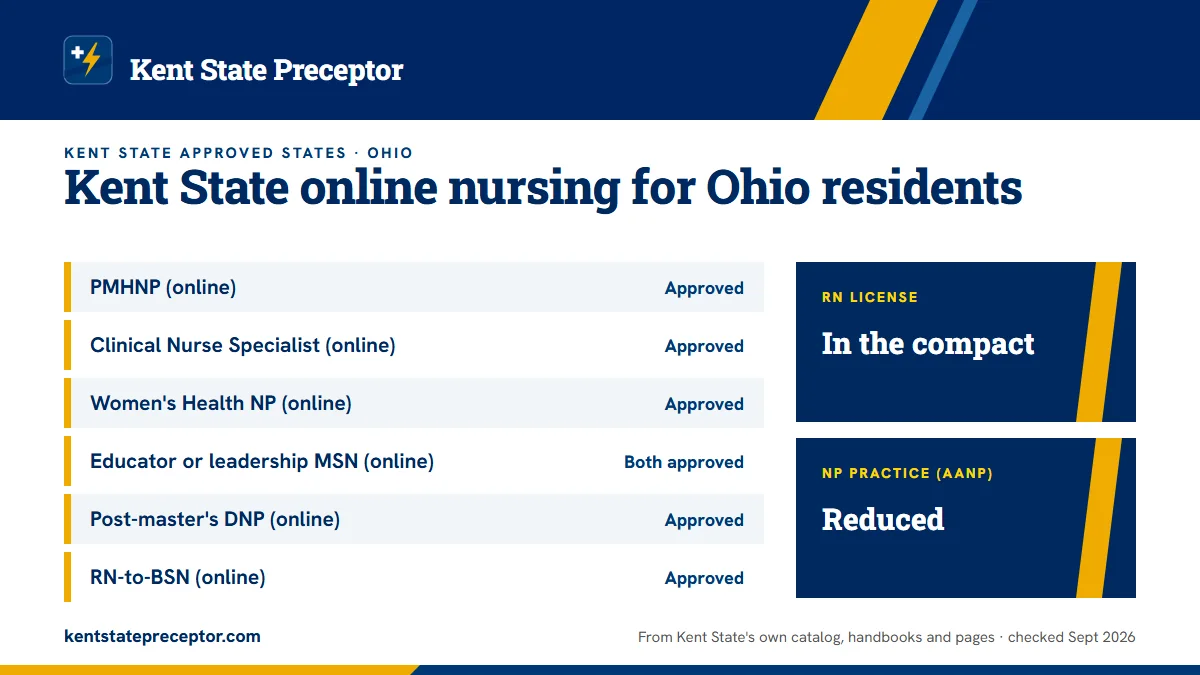
Ohio sits on all seven program lists of Kent State's approved-states page, and every row of its licensure disclosure that covers Ohio reads MEETS. The table joins both Kent State pages as read on September 24, 2026; other states are on the approved states page.
| Kent State program | Online enrollment from Ohio | Ohio licensure disclosure |
|---|---|---|
| PMHNP, MSN and post-master's certificate | Listed | MEETS |
| WHNP, MSN and post-master's certificate | Listed | MEETS |
| AGCNS, MSN and post-master's certificate | Listed | MEETS |
| Nurse Educator, MSN and certificate | Listed | Not on the disclosure (optional credential) |
| NAHSL, MSN and certificate | Listed | Not on the disclosure (optional credential) |
| DNP (post-MSN) | Listed | Not on the disclosure |
| RN-to-BSN | Listed | Not on the disclosure |
| FNP, AGPCNP, AGACNP (mostly online, Kent Campus) | Absent from the page for every state | MEETS |
| BSN and Accelerated BSN (in person) | Campus program, not online | MEETS |
Kent State says its APRN concentrations and certificates qualify graduates for Ohio APRN licensure and national certification; the undetermined wording on program pages concerns other states. The hybrid FNP, AGPCNP and AGACNP are Kent Campus programs, and the catalog asks anyone taking on-campus courses to hold an Ohio RN license.
Why Ohio is where Kent State practicum happens
The College of Nursing works out of Henderson Hall on the Kent Campus, and the MSN FAQ says no regional campus offers graduate nursing. The FNP, AGPCNP and AGACNP are labeled mostly online, meaning some courses require campus attendance; the FAQ says students in those tracks, and in the PMHNP, usually come to campus one day a week during the practicum sequence, typically years two and three. The catalog calls the PMHNP fully online, so confirm your cohort's pattern with your coordinator.
Ohio residents in the fully online WHNP, PMHNP, AGCNS, NAHSL, Nurse Educator and DNP programs complete practicum in person near home, with a preceptor they identify and practicum faculty approve.
Pre-licensure students train in Ohio too. The BSN runs in person at the Kent, Geauga, Salem, Stark and Trumbull campuses, with school-arranged clinicals mostly near each campus. The Accelerated BSN rotates across Northeast Ohio, chiefly Summit and Cuyahoga counties, and Kent State rules out completing those clinicals in another area or state. The BSN clinicals page covers the capstone preceptor.
Ohio APRN law: reduced practice and the standard care arrangement
The AANP classes Ohio as reduced practice. Before practicing, and for a whole career, a CNP, CNS or nurse-midwife needs a standard care arrangement (SCA) signed with a physician or podiatrist collaborator whose field matches or sits close to the nurse's own. A psychiatric-certified CNP or CNS may instead sign with a family practice, primary care, pediatric or psychiatric physician. The SCA stays with the employer, and the Ohio Board of Nursing must learn the collaborator's name within 30 days of the APRN starting work.
Prescribing has a ceiling of its own: a single physician can hold prescribing collaboration with five APRNs at most at any one time, while SCAs themselves are uncapped, and no APRN may prescribe beyond what the collaborator can.
For you, the SCA is the frame your Ohio NP preceptor already works inside, and physicians, collaborating physicians included, are on Kent State's list of possible preceptors. Bills to loosen the rule were pending, not law, as of June 2026: SB 258 and its House twin, HB 449, would release CNPs, CNSs and CNMs from the SCA after 2,000 clinical hours, and HB 508 puts that bar at 5,000. How all this shapes who can precept you is the subject of Ohio APRN practice and preceptors.
Ohio rules for nursing students and preceptors
Section 4723.32 of the Ohio Revised Code lets a student whose program leads to APRN authorization practice without an APRN license, as part of the program and supervised by an APRN acting for it as faculty, teaching assistant or preceptor.
Chapter 4723-5 of the Ohio Administrative Code, with its preceptor definition of an RN or LPN taking two students at most, covers only prelicensure programs such as Kent State's BSN. Our research found no Board approval step for graduate APRN programs or their preceptors; an APRN precepting in Ohio simply needs Ohio APRN licensure, built on an Ohio or multistate RN license.
So for graduate students, the working test is Kent State's own: the roles, license, experience and employer approval on Kent State's preceptor requirements. Two Ohio rules bind you directly. Since February 1, 2024, licensees, RN students included, must tell the Board within 30 days about a felony, a drug offense, an OVI or a misdemeanor tied to practice. And SB 109 (late 2024) requires informed consent before intimate examinations of unconscious patients, nursing students included.
Ohio health systems and what they publish for students
Kent State's clinical partners page, written for the whole college, names Summa Health, MetroHealth, Akron Children's, Aultman, Trumbull Regional, Northcoast Behavioral Healthcare, Mercy Health in Boardman, Warren and Youngstown, and Cleveland Clinic and University Hospitals sites from Akron General to UH Portage in Ravenna. Kent State students look at these systems, and each one rules on each request itself. Their public pages in September 2026 said:
- Cleveland Clinic: a single central application in three fixed cycles, and no direct calls or emails to its sites or caregivers.
- University Hospitals: the Behavioral Health Institute takes advanced practice student requests through a central application in three windows.
- MetroHealth and Aultman onboard students through ACEMAPP, MetroHealth with one application per preceptor.
- Akron Children's names Kent State on its APP student page for PNP, FNP, PMHNP and CNS students, who request placement through the school's coordinator.
- Summa Health names Kent State among undergraduate partners; its graduate list, described as not exhaustive, leaves Kent State off.
- Elsewhere: OhioHealth is not initiating new affiliation agreements, Kettering Health limits rotation applications to its employees plus PA students from Kettering College, and TriHealth, UC Health and ProMedica each require a school agreement.
Windows and onboarding steps, system by system, are on finding NP preceptors in Ohio. Whatever the system, no hour counts at a site lacking a current College of Nursing affiliation agreement, and the college sets those up with facilities.
Northeast Ohio and Portage County: shortage areas and workforce
HRSA's report as of June 30, 2026 lists 261 primary care shortage designations in Ohio, covering 4,449,937 people with 49.72% of need met; removing them would take 732 more practitioners. Ohio also has 139 mental health designations. Around the Kent Campus, HRSA's file downloaded September 24, 2026 shows these primary care designations:
| County | Designations | What they cover |
|---|---|---|
| Portage (Kent) | 4 | Low-income areas for Kent/Streetsboro, Ravenna and Garrettsville/Windham, plus one FQHC |
| Summit (Akron) | 9 | Low-income areas including East, South and West Akron, North Hill and Barberton, plus FQHC sites |
| Stark (Canton) | 4 | A countywide low-income designation plus three FQHC sites |
| Cuyahoga (Cleveland) | 12 | Low-income areas in Cleveland and its suburbs, plus FQHCs including MetroHealth's look-alike |
Counts shift often, but they help with planning: Kent State's AGPCNP rotation description asks for at least 16 underserved-care hours in the summer practicum, and a clinic serving one of these designated areas is a natural place to look.
The Board's FY2024 report shows 393 new APRN licenses (333 of them CNPs), and Kent State cites a BLS projection of 40.1% ten-year growth for NPs. Ohio offers preceptors no tax credit or state stipend that our research could find; a federal preceptor tax credit bill, H.R. 392, is pending.
Your Ohio license, for practicum and after graduation
For practicum, Kent State's catalog asks for an active, unrestricted Ohio RN license from anyone taking on-campus courses or completing hours in Ohio, and the Cleveland Clinic and UH student pages want an Ohio RN license too. Ohio's Nurse Licensure Compact membership took effect January 1, 2023; the APRN Compact is not law in Ohio. Kent State has not published whether another compact state's multistate license meets that wording, so ask the College's student services office; timing is on the RN license page.
After graduation, the Ohio Board of Nursing sets these steps toward an APRN license:
- Keep an active RN licenseOhio or multistate; a multistate holder based elsewhere applies as Non-OH RN MSL Seeking APRN.
- Transcript and paperworkYour program sends the transcript to the Board, and your concentration coordinator completes the licensure paperwork.
- Advanced pharmacologyA course within five years on the transcript, or 45 contact hours in that span, at least 36 from one provider.
- National certificationFrom a Board-approved organization, which verifies it with the Board directly.
- Apply on eLicense.Ohio.govCriminal history is screened against the disqualifying-offense list after you file.
- SCA and DEA before practiceReport your collaborator within 30 days; register with the DEA before prescribing controlled substances.
- Renew in odd yearsJuly 1 to September 15; from the second renewal, 24 CE hours per APRN license, 12 in pharmacology for non-CRNAs, beyond the RN's 24.
Why Ohio Kent State students choose us
Ohio placement has its own map, and we know it well: which systems take student requests only in a central window, which onboard through ACEMAPP, and when a practice will probably need a new College of Nursing agreement. Kent State students rely on us from Portage and Summit counties to Canton, Youngstown, Cleveland, Columbus, Dayton and Cincinnati.
We look for a preceptor near home, in person, who fits your exact Kent State course, whether a family practice NP for NURS 61292 or a psychiatric-mental health APRN who covers half or more of the PMHNP's fourth practicum. We gather the preceptor's Ohio license and national certification and the site's onboarding details into one file for your practicum faculty and concentration coordinator, raise the affiliation question on day one, and begin a replacement search at once if a preceptor steps away mid-semester. Start with your course number and county; the form is just below.
Questions Kent State students ask
Can I do my Kent State practicum at Cleveland Clinic?
Only through Cleveland Clinic's central application, which runs in three fixed cycles and asks for school approval, an active Ohio RN license and a current Cleveland Clinic agreement with your school. Its June 2025 agreements list includes Kent State, but each decision is Cleveland Clinic's, and silence by the notification date means no placement that cycle.
Will Ohio's APRN independence bills change who can precept me?
Not yet. SB 258, HB 449 and HB 508 would let experienced CNPs, CNSs and CNMs drop the standard care arrangement after 2,000 or 5,000 clinical hours, but none had passed as of June 2026. Either way, your preceptor standard comes from Kent State, and your practicum faculty and concentration coordinator sign off on each one.
Do I have to come to the Kent Campus if I live in Ohio?
It depends on your concentration. Practicum hours happen at a site in your community, not on campus. Campus days apply to the mostly online FNP, AGPCNP and AGACNP, while fully online programs need no campus visits. Kent State labels the PMHNP both ways, so confirm your own schedule with your concentration coordinator.
Is there an Ohio incentive I can mention when asking a preceptor?
Our research turned up no Ohio tax credit or state payment for preceptors, and the federal credit in H.R. 392 is still a bill. Kent State itself offers the Barbara Donaho award, continuing education through PreceptED, possible adjunct status and application-fee relief. How to raise those is covered on preceptor benefits.
I live in Ohio near Pennsylvania or West Virginia. Can my practicum cross the state line?
Kent State ties practicum to your home state, the one that issued your RN license, so an Ohio resident's hours normally stay in Ohio. A site across the line brings that state's board rules, a license question and usually a new affiliation agreement. Clear it with your concentration coordinator first; clinicals outside Ohio explains the rest.
Related pages
Last checked 2026-09-24
We check these pages against Kent State's own catalog, handbooks and program pages. Your MSN or DNP handbook, your syllabus, your practicum faculty and your concentration coordinator have the final word.
Kent State says the preceptor search is yours. We make it the fastest part of your practicum.
Tell us your Kent State concentration, where you live and which semester your next practicum starts. We find preceptors who fit the course and prepare everything your practicum faculty and coordinator review before they approve.
- Preceptors matched to the course: primary care for
NURS 61292, acute care forNURS 61092, psychiatric care forNURS 61592, women's health forNURS 66192 - Credentials, license and site details ready for your practicum faculty and coordinator
- In your own community, in Ohio or wherever you live and hold your RN license
Start your placement plan
Program, city and semester is all we need to begin.