Kent State Pediatric Primary Care NP: finishing five practicums in a concentration that is no longer admitting
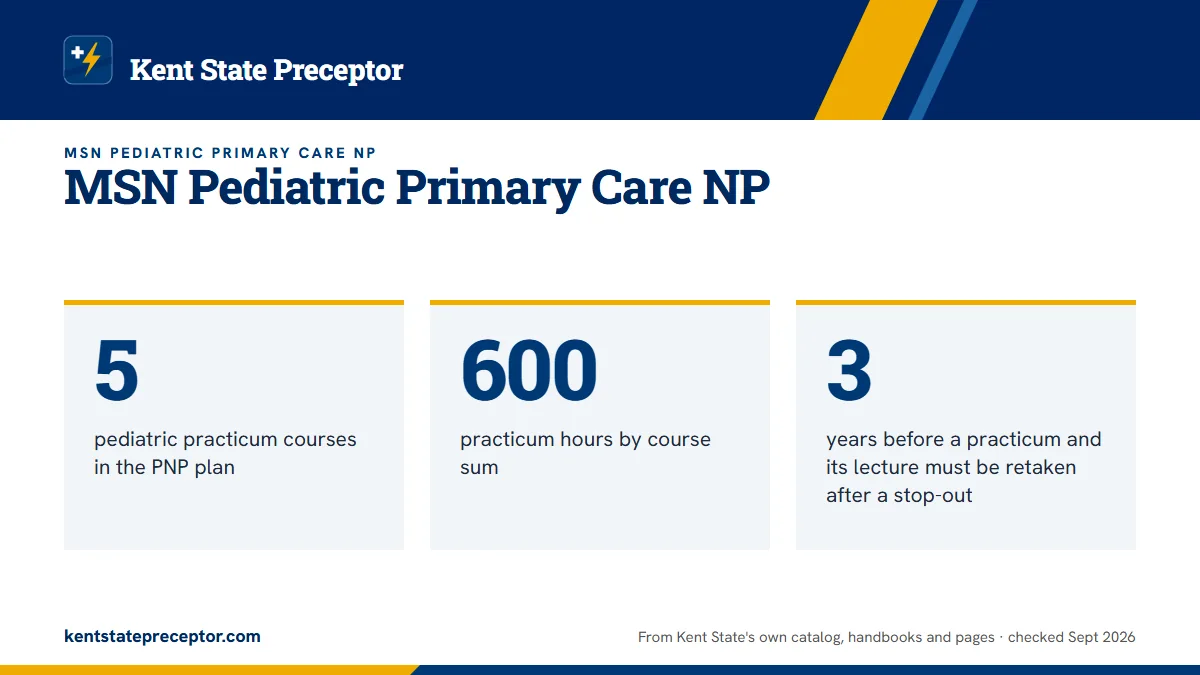
New applicants can no longer join Kent State's Pediatric Primary Care NP, but students already in it still complete five pediatric practicums that add up to 600 hours by course sum. This page is for those continuing students: how the sequence runs, who can precept it, and the time rules that matter most when a program is winding down.
Keep your PNP practicums on track
Tell us your county and which PNP course is next. We search pediatric primary care offices, clinics and health departments near you.
Where the PNP concentration stands
Kent State's 2026-2027 catalog marks the PNP concentration as closed to applications, and the AY 2025-2026 MSN Student Handbook dates the suspension of PNP certificate admissions to Fall 2024. Nothing in those sources ends the program for students already admitted, who continue through its courses and practicums.
The MSN concentration is 41 credits: 29 in the concentration and 12 in the MSN core. Kent State labels the MSN route mostly online from the Kent Campus, while the PNP certificate is labeled in person, so the two sources disagree on delivery. If your plan includes campus courses, confirm their dates with Kent State's Office of Academic Advising and Student Services.
The population is children from birth to age 21, in outpatient primary care and specialty settings. Graduates prepare for the Pediatric Nursing Certification Board (PNCB) primary care PNP exam.
Keeping a winding-down concentration on schedule
Timing matters more when a concentration is no longer admitting. Kent State's handbook asks every MSN and certificate student to keep a program plan in the Graduate Planning System (GPS), and it cautions that enrolling late can shut you out of courses you need and delay graduation. Keep your GPS plan current and confirm with your concentration coordinator when each remaining PNP course is offered.
Two catalog time rules apply. The first is the stale-course rule: after a stop-out, any practicum that has reached three years of age must be retaken with its paired lecture, and all five PNP pairs are on that list, from NURS 61792 with NURS 60170 through NURS 64792 with NURS 60470. Separately, the whole master's has a six-year clock that starts with your admission term; an extension request runs through the advising office, your coordinator and the Associate Dean of Academics.
The practicum time limits page explains how both rules are applied. Changes to the curriculum, new practicum-hour rules included, reach affected students by college email, so read it closely.
If you have stopped out, check the age of every completed PNP practicum before you plan your return. Three years is the line.
Five pediatric practicums, 600 hours
Along with the FNP, the PNP has the most practicum courses of any Kent State MSN concentration: five. Two of them are 1-credit courses of 75 hours, so the weekly load changes from term to term.
| Practicum | Credits | Hours | Paired lecture |
|---|---|---|---|
NURS 61792 Pediatric Assessment Practicum | 2 | 150 | NURS 60170 |
NURS 62792 PNP I Practicum | 2 | 150 | NURS 60270 |
NURS 63792 PNP II Practicum | 1 | 75 | NURS 60370 |
NURS 63992 Chronically Ill Child Practicum | 2 | 150 | NURS 60372 |
NURS 64792 PNP III Practicum | 1 | 75 | NURS 60470 |
| Total by course sum | 8 | 600 |
The 600 total is our sum of the course descriptions, matching the upper end of the MSN graduation range in the catalog. With 75 hours to each credit, expect roughly 10 clinic hours weekly in the 2-credit courses and roughly 5 in the 1-credit ones. NURS 61792 lists NURS 60045 Pathophysiology and NURS 60101 Theoretical Basis for Nursing Practice as prerequisites.
Pediatric preceptors and settings
Kent State's PNP rotation page points to pediatric primary care offices, clinics and health departments, and it excludes retail minute clinics. Later practicums move into chronic-care specialties, which fits the NURS 63992 focus on chronically ill children.
The college's general graduate rules set the preceptor bar: an APRN, physician or physician assistant with an active, unrestricted license and certification, employer approval, and, on the APRN rotation pages, a year or more in pediatric practice and role. Our preceptor requirements guide covers the rules in full.
Among the clinical partners Kent State names is Akron Children's, alongside other Northeast Ohio systems, though a partner listing says nothing about whether a given office has room in a given term. Pediatric hours count only at an office that already has, or is given, a current affiliation agreement with the College of Nursing.
States and licensure for PNP students
As a mostly online concentration, the PNP has no row on the approved-states list for online learning, and no out-of-state enrollment rule is published for it. Pediatric hours are in person, in a state where you hold an active, unrestricted RN license. Thinking about relocating? Let the Office of Student Services know before you go, because some state laws block practicum courses. Kent State has belonged to SARA since 2015, yet that reciprocity leaves licensing boards out, and a host state's nursing board may still need to approve clinical work inside its borders.
After graduation, the disclosure table's does-not-meet row for MSN NP concentrations, the PNP among them, holds three names: California, New York and American Samoa. Certificate completers face a longer list that adds Arkansas and New Hampshire to those three. The licensure disclosures page explains how to read both.
Certification and your hour record
PNP graduates sit for the PNCB's primary care pediatric nurse practitioner exam and qualify for Ohio APRN licensure, as Kent State describes its APRN concentrations. Before you finish, your coordinator completes the certification and licensure forms.
Your hours live in the NP database in Typhon, where every clinical day's time and case logs must be in within 15 days, and your preceptor submits the final evaluation there. Faculty also complete hour-verification forms for preceptors at the end of each semester, so accurate logs matter to them as well as to you. Typhon access lasts five years after graduation, so your PNP logs stay available after you finish. Graduation also needs a 3.000 overall GPA, and any practicum grade below B brings a semester warning; see grades and probation for what follows.
Why continuing PNP students choose us
When a concentration is winding down, a lost term costs more, so the preceptor search has to be ready before each course opens. We plan your remaining PNP practicums as one sequence and look for pediatric primary care offices, clinics and health departments near your home, then chronic-care settings for the later courses.
We vet pediatric license, certification and experience first, then hand you what your faculty and coordinator need to approve. An office without a college agreement is flagged from day one, since the college arranges those and needs lead time.
If a pediatric preceptor pulls out mid-term, we begin looking for a replacement straight away; the preceptor dropped out page covers your own first steps. Your county and next PNP course, sent through the form below, start the search.
Questions Kent State students ask
Is Kent State still offering the Pediatric NP program?
Not to new students. Applications are closed for both the MSN concentration and the certificate, with certificate admissions suspended since Fall 2024. Students already admitted continue through the five practicums, so if you are one of them, keep in close touch with your concentration coordinator about course timing.
Can a pediatrician precept a Kent State PNP student?
Physicians are among the roles Kent State accepts as graduate preceptors, and the PNP rotation page centers on pediatric primary care offices, clinics and health departments. A pediatrician practicing in one of those settings fits that profile. Your practicum faculty and concentration coordinator approve each preceptor, so bring them the physician's license and board certification details.
Can PNP practicum hours be done at a retail clinic?
No. Kent State's PNP rotation page excludes retail minute clinics. Look instead at pediatric primary care offices, clinics or health departments for the early practicums, and at chronic-care specialty settings for the later ones. Check each option with your practicum faculty before you commit, since the syllabus sets what each course needs.
I stopped out of the Kent State PNP. Can I come back?
Start with two dates: your admission term, since the master's must be done within six calendar years of it, and the date of each completed practicum, since any that are three or more years old must be repeated with their lectures. Then ask your graduate advisor and your coordinator when the remaining PNP courses run.
Related pages
Last checked 2026-09-24
We check these pages against Kent State's own catalog, handbooks and program pages. Your MSN or DNP handbook, your syllabus, your practicum faculty and your concentration coordinator have the final word.
Kent State says the preceptor search is yours. We make it the fastest part of your practicum.
Tell us your Kent State concentration, where you live and which semester your next practicum starts. We find preceptors who fit the course and prepare everything your practicum faculty and coordinator review before they approve.
- Preceptors matched to the course: primary care for
NURS 61292, acute care forNURS 61092, psychiatric care forNURS 61592, women's health forNURS 66192 - Credentials, license and site details ready for your practicum faculty and coordinator
- In your own community, in Ohio or wherever you live and hold your RN license
Start your placement plan
Program, city and semester is all we need to begin.