Kent State DNP project courses: proposal, implementation and defense
Every Kent State DNP concentration ends in the same trio: NURS 72692 Project I, NURS 72792 Project II and NURS 72892 Project III. Each is 3 credits with a required practicum of 150, 250 and 150 hours, and together they carry your evidence-based practice project from a passed proposal, through IRB review with your site, to a defense before your committee.
Find a site for your DNP project
Tell us your concentration, your state and your project idea. We look for an organization that can host all three courses.
NURS 72792, the implementation course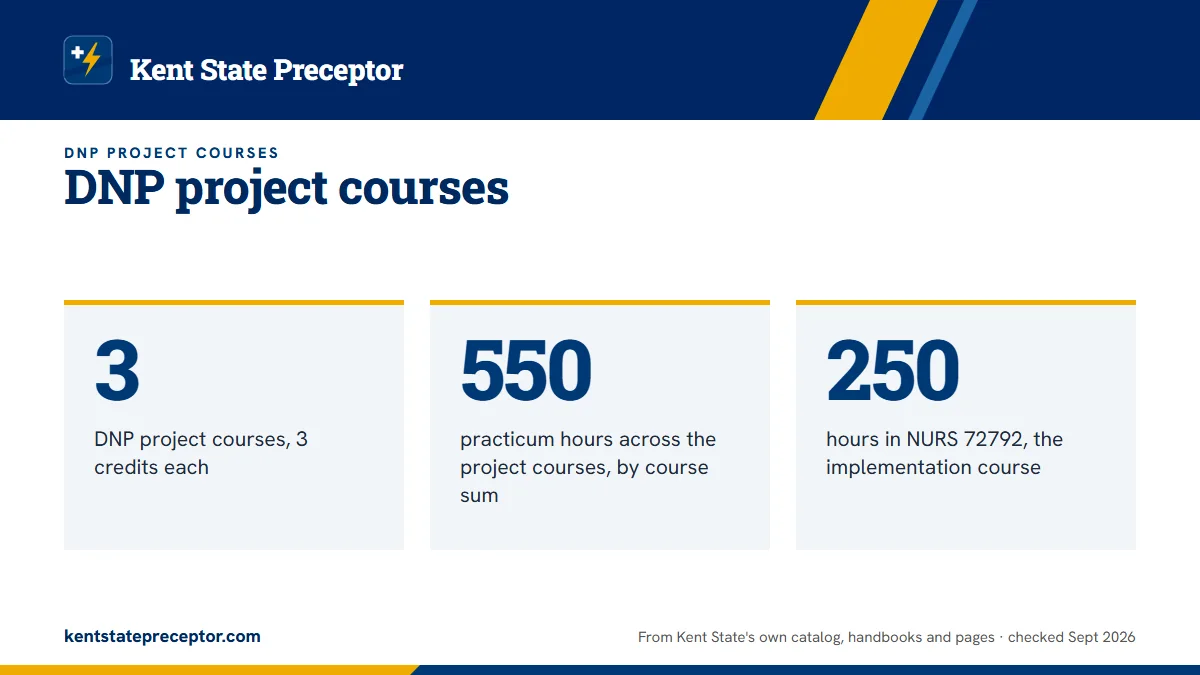
The three project courses at a glance
The project sequence is the 9-credit culminating requirement inside the DNP core. Each course names a required practicum: 150 hours for planning and the proposal, 250 for implementation and evaluation, and 150 for analysis and interpretation. That adds up to 550 hours by course sum.
Kent State's graduation rule asks post-master's students for at least 500 practicum hours, and an older course description uses 525. How those three figures relate is the subject of the DNP practicum hours page; this page follows the courses themselves.
| Course | Credits | Practicum hours | Ends with |
|---|---|---|---|
NURS 72692 D.N.P. Project I: EBP Project Planning and Proposal | 3 | 150 | Passing the project proposal |
NURS 72792 D.N.P. Project II: Implementation and Evaluation | 3 | 250 | The project carried out at your site, including IRB review with the site |
NURS 72892 D.N.P. Project III: Data Analysis and Interpretation | 3 | 150 | The defense and scholarly writing |
NURS 72692 Project I: planning and the proposal
Project I is where the project takes shape. Its 150 practicum hours go to planning an evidence-based practice project, and the course ends when your project proposal passes. According to the post-master's FAQ, project work starts in semester one, when each student is also paired with a faculty advisor.
Kent State counts project development, implementation and evaluation time as DNP practicum hours, so planning work with your site already builds your total. The FAQ treats finding a preceptor as mainly your task, with faculty backing, and Kent State names the Director of the DNP Program among the people who help DNP students look.
Because Project II runs the project at the site, choose an organization in Project I that can host it through Project III. Our guide to finding your own preceptor covers the shared-search rule behind that choice.
NURS 72792 Project II: implementation, evaluation and IRB
Project II is the longest practicum at 250 hours, and it is where the project goes live. The catalog includes IRB review with the site in this course, so find out during Project I how your organization's review works, who signs off and how long it usually takes there.
Hours at an organization count only after the College of Nursing has a current affiliation agreement with it, and it is the college that sets that up with the facility. The affiliation agreements page explains why a new organization needs lead time.
Compliance matters here as much as in any MSN practicum. The Clinical Compliance Policy covers DNP students, and the graduate handbook stops hours from counting during any lapse, a yearly TB test or flu shot included, so check your expiry dates before implementation starts.
NURS 72892 Project III: analysis, writing and the defense
Project III spends its 150 hours on data analysis and interpretation, and it ends with the defense and scholarly writing. The DNP graduation rules call for a defended scholarly project before a committee made up of your advisor and two members with doctoral preparation, and the project should yield a publishable manuscript.
A DNP Project Chair oversees the project hours and, in Kent State's description, the proposal, any IRB approval, implementation and the defense. On the five-semester post-master's schedule, the project should be finished in the fifth semester.
The DNP sets a B as the floor in every course. Fall below it and you retake the course before anything that depends on it, and two grades under B put your place in the program at risk, so a stalled Project II can hold up Project III. The grades and probation page covers the wider rules.
The legacy practicum and the other DNP routes
NURS 70592 Doctoral Nursing Practice Practicum is still in the course inventory: 1 to 2 credits, repeatable, graded satisfactory or unsatisfactory, with a stated minimum of 7 credits equal to 525 hours. It no longer appears in the DNP requirements, which use the three project courses, so check with your advisor if an older plan or document still names it.
The project courses are shared across concentrations. Executive Nurse students earn all their practicum hours in them. Practice Leadership students take them too, and those who enter with a BSN reach them after completing an MSN APRN concentration and national certification. NAEL students take them in addition to four leadership practicum and seminar courses: NURS 70292, NURS 74292, NURS 74302 and NURS 74692. The BSN to DNP page covers those routes.
Where your project can happen
The DNP is fully online. The DNP FAQ says you can do the project in the state where you live and are licensed as an APRN, while the 2026-2027 catalog, which lists non-APRN concentrations, asks for an RN license valid where the practicum happens. The catalog is the newer document; confirm your case with the DNP program director.
The post-master's DNP has 16 approved states, listed on approved states. No DNP handbook exists for 2025-2026, so your syllabi, your faculty advisor and your Project Chair are the working references for project rules. If your organization sits outside Ohio, SARA membership stops short of nursing boards, so a host-state board may need to approve the clinical work; clinicals outside Ohio explains how that plays out.
Why DNP students choose us for project sites
We look for an organization that can host your project from proposal through defense, and a preceptor whose role fits your concentration and your project question. For each site, we set out the preceptor's credentials, the organization's review steps and whether the college must put an affiliation agreement in place, so your advisor and Project Chair see the full picture early. We keep the project calendar in view as well: 150 hours for the proposal, 250 at the site and 150 for analysis, so the organization knows what each term asks of it.
If the site you planned on falls through before implementation, we start a replacement search right away and match the new organization to the proposal you have already built. Describe your concentration, state and project idea in the request form, and read how it works for our steps.
Questions Kent State students ask
Is my own employer allowed as a DNP project site?
Kent State publishes no workplace ban for DNP students; the only published ban covers the PMHNP. An organization you already know can work well, but it still needs a current college affiliation agreement, a preceptor your faculty accept, and run a review process that can clear the project in Project II. Ask your Project Chair early.
How long does IRB review take for a Kent State DNP project?
Kent State publishes no timeline. The catalog places IRB review with the site inside NURS 72792, and the Project Chair oversees any IRB approval. Each organization runs its own process, so ask your site during Project I how its review works and how long it usually takes, then build that into your implementation plan.
Do project hours count toward the DNP practicum minimum?
Yes. The three project courses each name a required practicum, 150, 250 and 150 hours, and Kent State treats project development, implementation and evaluation time as practicum time. Those add up to 550, above the catalog's 500-hour floor for post-master's students. Your syllabus and Project Chair confirm how each course's hours are logged.
Can I change project sites between Project I and Project II?
Kent State publishes no rule on switching sites mid-sequence. In practice, your passed proposal is built around one organization, and Project II includes IRB review with the site, so a new site means reworking those pieces and confirming an affiliation agreement. Raise any change with your Project Chair as soon as the original site wavers.
How are the DNP project courses graded?
The catalog's DNP rules require a minimum grade of B in every course, and the older NURS 70592 practicum was graded satisfactory or unsatisfactory. The grading method for each current project course is set out in its syllabus. Read it at the start of Project I, since a grade below B has to be retaken before you move on.
Related pages
Last checked 2026-09-24
We check these pages against Kent State's own catalog, handbooks and program pages. Your MSN or DNP handbook, your syllabus, your practicum faculty and your concentration coordinator have the final word.
Kent State says the preceptor search is yours. We make it the fastest part of your practicum.
Tell us your Kent State concentration, where you live and which semester your next practicum starts. We find preceptors who fit the course and prepare everything your practicum faculty and coordinator review before they approve.
- Preceptors matched to the course: primary care for
NURS 61292, acute care forNURS 61092, psychiatric care forNURS 61592, women's health forNURS 66192 - Credentials, license and site details ready for your practicum faculty and coordinator
- In your own community, in Ohio or wherever you live and hold your RN license
Start your placement plan
Program, city and semester is all we need to begin.